
Mormonism Explained
The Mormon Stories Playbook
Inside John Dehlin’s Million Dollar Formula for Leading Members Out of the Church
Key Findings
What This Investigation Documents
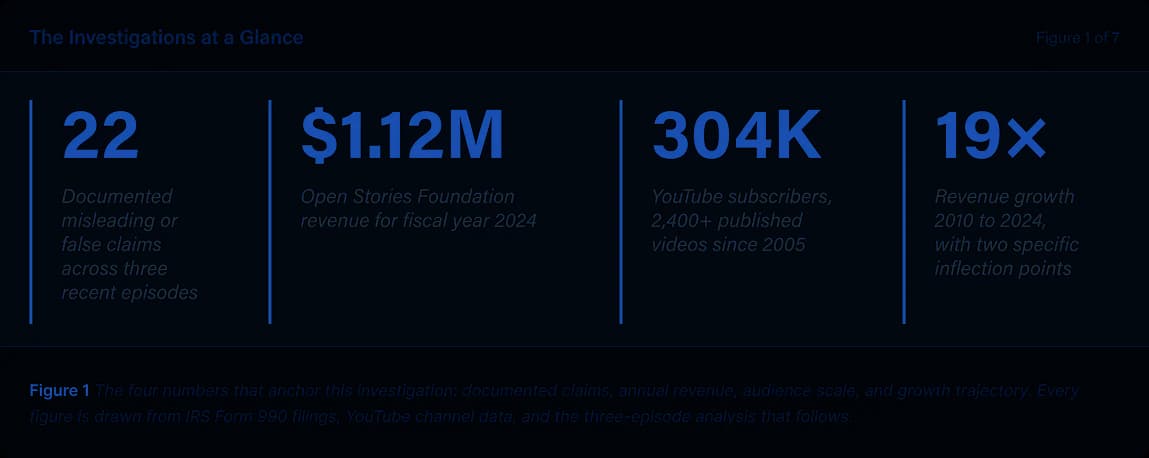
On April 17, 2026, The Church of Jesus Christ of Latter-day Saints filed a federal trademark and copyright lawsuit against the Open Stories Foundation and John Dehlin, host of the Mormon Stories podcast. This investigation examines three interconnected patterns that the lawsuit alone does not fully capture.
- Branding mimicry. In December 2022, Mormon Stories adopted a blue logo with arched framing, a centered figure, and radiating light rays that mirror the official visual system of the Church. Contemporaneous social media comments, audience testimonials, and exhibits in the federal complaint document widespread confusion between the podcast and official Church content.
- An editorial formula. Across three representative recent episodes of Mormon Stories, we documented 22 claims that are misleading, overstated, or demonstrably false when compared against primary sources, Church scholarship, and the podcast’s own expert guests.
- Financial trajectory and governance concerns. The Open Stories Foundation reported $1,120,862 in 2024 revenue, with Dehlin receiving $248,084 in personal compensation — approximately 22 percent of the organization’s revenue. In 2021, a former associate producer filed an IRS whistleblower complaint, reported by the Salt Lake Tribune in February 2022, alleging self-dealing. The complaint remains publicly unresolved.
The lawsuit is the visible surface. This is the story underneath it.
A Note Before We Begin
This piece is critical of the Mormon Stories podcast and its host, John Dehlin. It is not a critique of the people who have listened to the show, the people who have left the Church, or the people who remain in transition between those two places. Many of the listeners we quote in the sections that follow are dear to their families and dear to the Saints who know them. The question this article examines is not whether doubts are valid — they are — or whether critical content should exist — it should. The question is whether one of the largest platforms in this space has, over twenty years, constructed a repeatable editorial formula that leads audiences toward one outcome while presenting itself as neutral exploration. The evidence, we believe, says yes.
We should also state our own standing directly. Mormonism Explained is a 501(c)(3) nonprofit that holds an active trademark license with Intellectual Reserve, Inc. — the same Church-affiliated entity that filed the current complaint against the Open Stories Foundation — covering our use of the words “Mormon” and “Mormonism” in our organization’s name. We walked through the licensing process voluntarily before we launched. We disclose this because readers deserve to know it, and because the distinction the Church is drawing in the Mormon Stories complaint — between commentary about the Church and branding that audiences mistake for the Church — is the exact line the licensing process exists to draw.
What the Mormon Stories Lawsuit Is Really About
On April 17, 2026, The Church of Jesus Christ of Latter-day Saints and Intellectual Reserve, Inc. filed a federal complaint against the Open Stories Foundation and its founder, John P. Dehlin, in the U.S. District Court for the District of Utah. The filing, Case No. 2:26-cv00321, brings four counts: federal trademark infringement, false designation of origin under the Lanham Act, trademark infringement under Utah common and statutory law, and copyright infringement. The complaint alleges a pattern of overlapping branding choices — a blue round logo adopted in late 2022, a light-rays design motif, typography reminiscent of Church materials, and unlicensed use of Church-owned photography — that, taken together, were calculated to cause audience confusion about source and affiliation.
We have already covered the lawsuit itself in a separate news piece on this site. This article is not about the lawsuit. This article is about what the lawsuit is pointing at: a two-decade operation that has grown from a small podcast into a seven-figure media platform with a consistent editorial pattern, a well-documented impact on real families, and a financial structure that has drawn IRS scrutiny.
The branding dispute matters because it is how the audience arrives. But the audience does not stay because of the logo. They stay because of a formula. And that formula is the actual story.
Key Takeaway
The lawsuit is the visible surface of the story. What it points at — a twenty-year editorial operation, a seven-figure nonprofit, a 2021 IRS whistleblower complaint, and documented audience confusion — is what this investigation examines.
Who Is John Dehlin? A Twenty-Year Biographical Arc
To understand the arc of Mormon Stories, it helps to understand the arc of the person who built it.
John Dehlin was raised in Katy, Texas, as a fifth-generation Latter-day Saint. By his own telling, he was devout and active. He served a full-time mission in Guatemala from 1988 to 1990. He graduated summa cum laude from Brigham Young University in 1993 with a degree in political science. He married in the temple. He pursued a career in technology and consulting, working for Bain & Company, Arthur Andersen, Citicorp, Heidrick & Struggles, Microsoft, and — briefly — the LDS Church itself. In 2004, he moved to Logan, Utah, to work at Utah State University on open-education projects that would eventually lead him to MIT.
This biography matters because it forms the original credibility of Mormon Stories. When Dehlin launched the podcast in September 2005, he did so as a believing, active member. His stated purpose at the time was, in his own framing, to give fellow Latter-day Saints reasons to remain in the Church. The show interviewed scholars, disaffected members, and faithful voices alike. It was marketed as a space for Mormons in transition to find community rather than to be pushed toward any particular exit.
That framing — “we’re just here to listen” — would remain the public posture of Mormon Stories for the next twenty years. What changed, slowly, was the center of gravity of the show’s content.
Between 2011 and 2014, Dehlin himself underwent an accelerating transition. In spring 2011, he stopped attending church services. In early 2014, his bishop initiated an investigation into his public advocacy. In June 2014, his new stake president sent a letter referencing a public bio in which Dehlin stated he no longer believed “many of the fundamental” claims of the Church. That summer, Dehlin briefly published — and then revised — a document titled “Questions and Answers” on the Mormon Stories website in which he described the Book of Mormon and the Book of Abraham as works of fiction, alleged that Joseph Smith had married women as young as fourteen and the wives of other men, and characterized Joseph’s account of polygamy as public deception. Faithful historians and apologists have responded at length to the specific claims in that document; our point here is not to relitigate each one but to note what the document represents: the public crossing of a line from “exploring doubts” to publicly advocating a non-historical, fraud-based reading of the faith.
In January 2015, a disciplinary council was convened. Dehlin was excommunicated. The letter from his stake president cited three grounds: teachings disputing the nature of God and Jesus Christ; statements characterizing the Book of Mormon and Book of Abraham as fraudulent; and statements rejecting the Church as the true Church with authority from God. Dehlin publicly framed the excommunication as a reprisal for his views on same-sex marriage and female ordination. The Church, in a rare public response, corrected the record, noting that those topics appeared nowhere in the council’s stated reasons.
The excommunication was, by any objective measure, the most successful business event in the history of Mormon Stories. Annual revenue at the Open Stories Foundation rose from $198,136 in 2015 to $332,678 in 2016 — a 67 percent jump in a single year, correlated with the public visibility the disciplinary council produced. The podcast’s audience grew. Dehlin, who had spent a decade positioning himself as an insider exploring doubts, was now a formal outsider. The show’s editorial posture shifted accordingly. What had been framed as a space for the questioning became, increasingly, a space for the departing.
That is the arc. A believing insider in 2005. A public critic of Church truth claims by 2014. An excommunicated outsider running a rapidly growing nonprofit by 2016. A seven-figure media operation by 2023. And now, in 2026, a federal defendant.
The trademark case is the exclamation point. The formula is the sentence that came before it.
Key Takeaway
A believing fifth-generation Latter-day Saint launched a podcast in 2005 with a stated mission to help members remain in the Church. Twenty-one years later, that same person is a federal defendant running a seven-figure nonprofit whose revenue has grown nineteen-fold since launch. Between those two moments, something changed — and the financial record tracks the change precisely.
Why Mormon Stories Looks Like the LDS Church — The Branding Case
Mormon Stories has been using the word Mormon in its name since 2005, and Dehlin is correct when he notes that the Church did not object to the name itself for most of that time. Names alone rarely trigger trademark disputes when the context and visual identity are clearly distinct. The case the Church brought in 2026 is not about the word Mormon. It is about a specific, documented cluster of choices that began in December 2022.
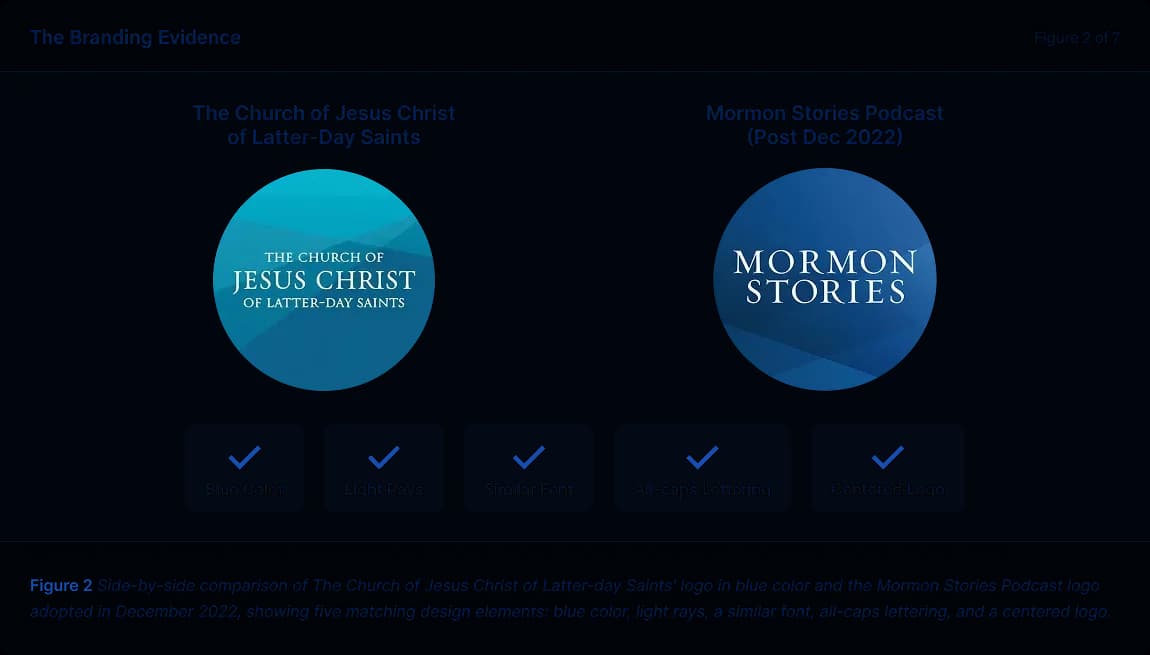
Before December 2022, the Mormon Stories podcast logo was brown. After December 2022, it was deep blue — a blue nearly indistinguishable, at glance distance, from the blue the Church uses on its Christus-centered primary symbol. The blue logo sits inside an arched frame. The arched frame contains a centered figure silhouette. Radiating light rays extend above the figure. The wordmark beneath it is set in an all-caps serif. Each of these choices, viewed individually, might be explained away as coincidence. Stacked together, they describe the Church’s own visual system.
Key Takeaway
Five design choices that individually might read as coincidence — but taken together describe the Church’s own visual system. Paragraph 48 of the federal complaint alleges the blue Mormon Stories logo was adopted “with full knowledge” of the Church’s Light-Rays Design Marks.
Facebook commenters on the Mormon Stories page noticed immediately. Screenshots included in the complaint document viewers writing variations of “it’s giving LDS logo vibes” and “it’s more like the Book of Mormon.” Those comments are dated 2022 and early 2023. They are contemporaneous evidence that the branding change registered with the podcast’s own audience as Church-adjacent — not after a trademark case was filed, but in the first weeks the new logo was live.
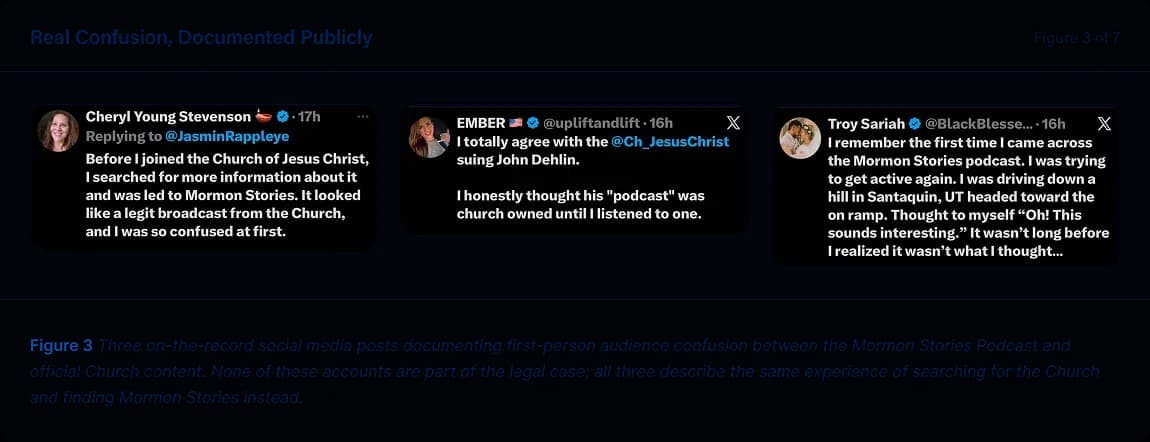
The confusion was not limited to casual design commentary. In public replies to the lawsuit filing, multiple Latter-day Saints — including users who have no affiliation with the Church’s enforcement framework — described firsthand mistakes.
Key Takeaway
The confusion is not abstract. Real Latter-day Saints — including prospective converts and members trying to reactivate — arrived at the podcast thinking they had found the Church. Some did so recently. Some did so years ago. The pattern is consistent.
None of these accounts is part of the legal case. All of them describe the same experience: looking for the Church, finding Mormon Stories, and initially mistaking one for the other.
That pattern is what trademark law is designed to prevent. Trademark protection exists primarily to shield consumers from being misled about what they are consuming. The point of the legal framework is not to protect the trademark holder’s ego or market position — it is to protect the person on the receiving end from thinking they are getting one thing when they are actually getting another.
Before filing, the Church proposed a resolution so modest that the refusal of it is itself part of the story. The Church asked for a brief disclaimer, verbal or written, at the beginning of each podcast episode, acknowledging that Mormon Stories is not affiliated with or endorsed by the Church. That is it. No content restrictions. No changes to editorial direction. No review of guests or topics. A single sentence at the top of each episode.
Dehlin refused. His public explanation, issued after mediation broke down, framed the request as unreasonable and described himself as unwilling to be bullied. But the request was not unusual. It is standard practice for small faithful creators in this space to include exactly this kind of disclaimer on their channels, voluntarily, simply as a matter of clarity. Other creators contacted by the Church over the years — including the producers of Come, Follow Me-style home-study podcasts in 2019 and Utah YouTuber Aubrey Laidlaw in 2012 — took the cooperative route, made requested changes, and moved on. The BYU student newspaper did the same when approached by university counsel. Cooperation was never the only available path. It was the path most creators chose.
The disclaimer refusal tells us something important about the podcast’s business model. The most plausible reason to refuse a single sentence that would take fifteen seconds of airtime is that the ambiguity itself has value. A listener arriving at the show uncertain whether it is faithful or critical is a listener who will stay for at least one episode to find out. That listener, over time, becomes a subscriber. That subscriber becomes a donor. The ambiguity is the top of the funnel.
That is the bait. It is step one. What happens to the listener after they arrive is the formula.
Key Takeaway – Part 1
The December 2022 rebrand was not subtle. Five specific design elements mirror the Church’s visual system. Contemporaneous audience confusion is documented in the lawsuit’s own exhibits. The Church asked for one short opening-of-episode disclaimer. Dehlin refused. The most plausible reason to refuse is that the ambiguity itself has business value.
The Mormon Stories Editorial Formula — Austin Fife’s Five-Step Framework
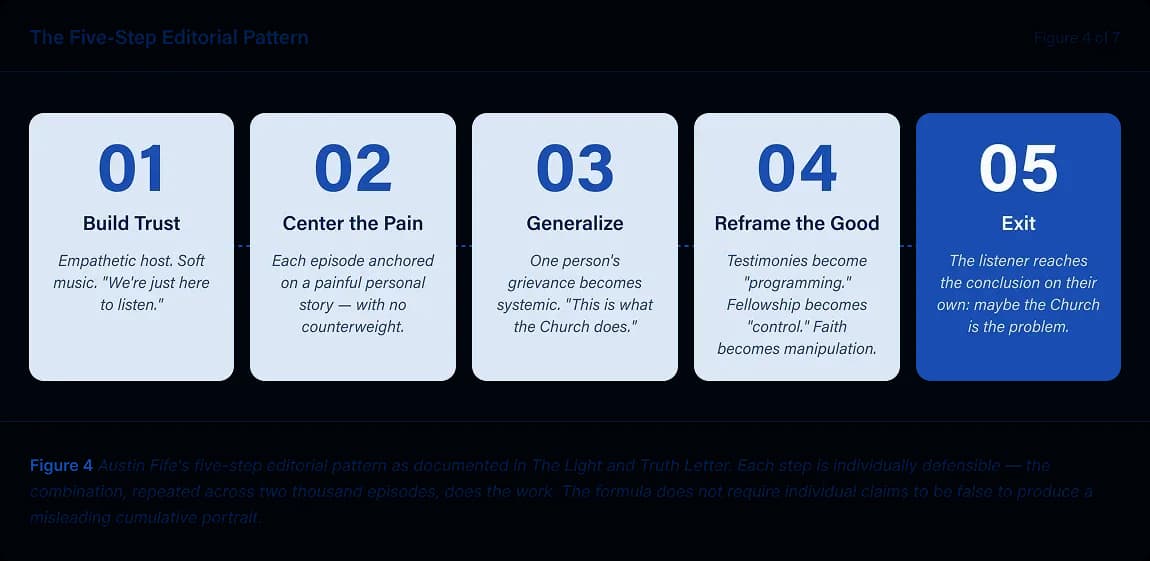
One of the clearest descriptions of how Mormon Stories functions editorially comes not from the Church, and not from Mormonism Explained, but from a private reader named Austin Fife, who underwent his own faith transition, listened to the podcast extensively, and later wrote about the experience in a book titled The Light and Truth Letter. Fife’s observation describes the show’s editorial approach as a repeatable formula: “I eventually stopped listening to Mormon Stories when I caught on to the formula. The show became predictable.” We reproduce his framework here because it has held up under scrutiny across hundreds of episodes and is, in our judgment, the single most useful lens for understanding what the podcast actually does.
The formula, as Fife describes it, operates in five steps. Each step is individually defensible. It is the combination, executed episode after episode for twenty years, that does the work.
Key Takeaway – Part 1
The pattern is repeatable, predictable, and effective. A listener who consumes fifty episodes of this formula will walk away believing painful Church experiences are typical, not exceptional — regardless of whether any single claim in any single episode is factually inaccurate.
Step one is to build trust. The host is warm. The music is gentle. The opening minutes of an episode carry a tone of we’re just here to listen. No Latter-day Saint listener should feel this trust is manufactured cynically in the moment — Dehlin and his guests are, in most cases, genuinely curious and genuinely empathetic. The trust is real. That is part of why the formula works. A listener who has never been treated warmly by a faithful interlocutor about their doubts often encounters Mormon Stories and thinks: finally, someone who will actually hear me out. The trust is not a lie. It is the precondition for everything that follows.
Step two is to center the pain. Each episode is anchored on a guest with a deeply personal, often painful, experience with the Church — a mission that broke them, a marriage that fractured, a bishop who failed them, a doctrine that hurt them. These stories are, in the overwhelming majority of cases, real and true. The guests are not lying. But the editorial choice to center pain, episode after episode, with no counterweight, shapes the cumulative picture. A listener who hears fifty painful stories in a row, with no stories of healing, grace, or faithful flourishing to balance them, will conclude that painful stories are the typical Latter-day Saint experience. They are not. They are a subset — a real subset, worth hearing — but a subset.
Step three is to generalize from the individual to the institutional. The host responds to a guest’s specific grievance by extrapolating it into a systemic claim about the Church. “And this is what the Church does” becomes a reflexive framing move. One person’s bishop who mishandled their confession becomes the bishops. One person’s mission companion who modeled dishonesty becomes the mission culture. One person’s Relief Society that shunned them becomes the Relief Society. The rhetorical move is small. The cumulative effect, over hundreds of episodes, is total.
Step four is to reframe the positive as manipulation. The good things about the Church — genuine fellowship, testimony bearing, missionary zeal, covenant relationships, temple worship — are recast as instruments of control. Sincere faith becomes “programming.” Spiritual experiences become “emotional manipulation.” The word community acquires scare quotes. This move is particularly damaging because it forecloses a listener’s ability to name any good in the institution without suspecting themselves of having been deceived. The listener’s own positive experiences become, retroactively, evidence of a con.
Step five is exit. By the end of the episode — and certainly by the end of enough episodes — the listener arrives at a conclusion that they experience as their own: maybe the Church really is the problem. They were never told to reach that conclusion. No host ever said you should leave the Church. The formula is more respectful than that. The formula simply ensures that no other conclusion is reachable from the set of premises presented. The exit is not pushed. The exit is the only door left unlocked.
This is the framework. Let’s now look at the evidence for it.
Key Takeaway – Part II
The formula does not require individual claims to be false. It requires only that the cumulative portrait be unbalanced in one direction, episode after episode, for twenty years. Dehlin very likely believes what he is saying. That does not change what the pattern produces for the listener.
The Evidence — 22 Misleading or False Claims in Three Mormon Stories Episodes
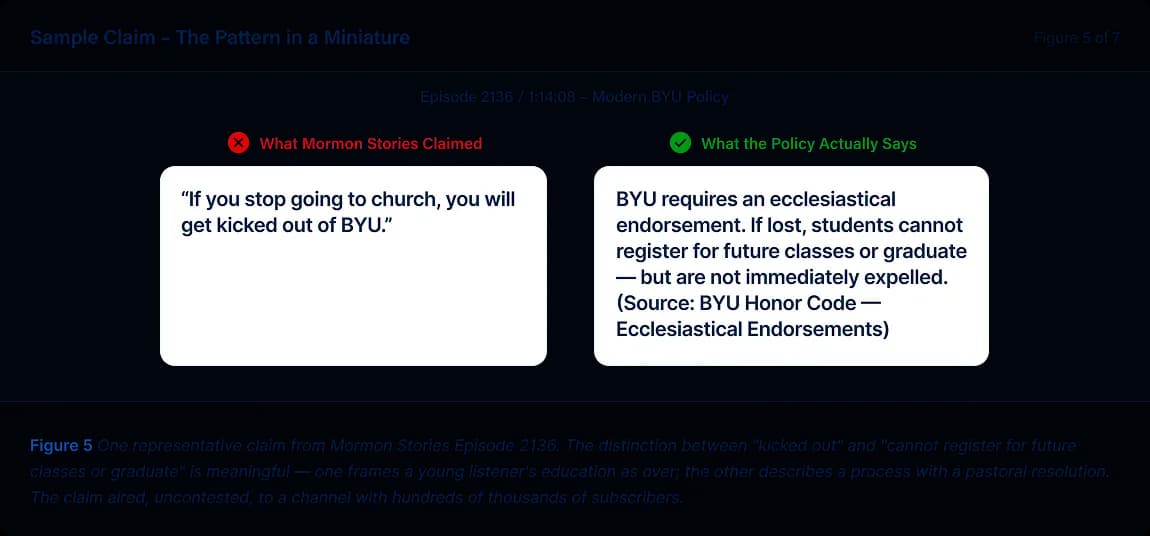
Below, we’ve documented specific claims across three recent episodes of Mormon Stories. Each claim is timestamped, each insinuation is named, and each is set against the primary evidence — usually from a Church source, a peer-reviewed historian, or the historian actually appearing on the podcast as a guest. The purpose of these tables is not to refute every claim Dehlin has ever made. The purpose is to demonstrate the pattern: across three unrelated episodes, spanning both historical starkest example of a demonstrably false factual assertion that aired uncontested:
Key Takeaway
This is one claim. Across three recent episodes, we documented twenty-two. The full tables follow — every claim timestamped, every rebuttal sourced against primary documents.
Episode 2137 — “Traitor in the First Presidency, William Law”
With historian John Turner, Dehlin discussed the final months of Joseph Smith’s life. Turner himself is a careful historian whose book treats the period with nuance. The following claims, pressed by Dehlin rather than by Turner, shifted that nuance toward cynical certainty.
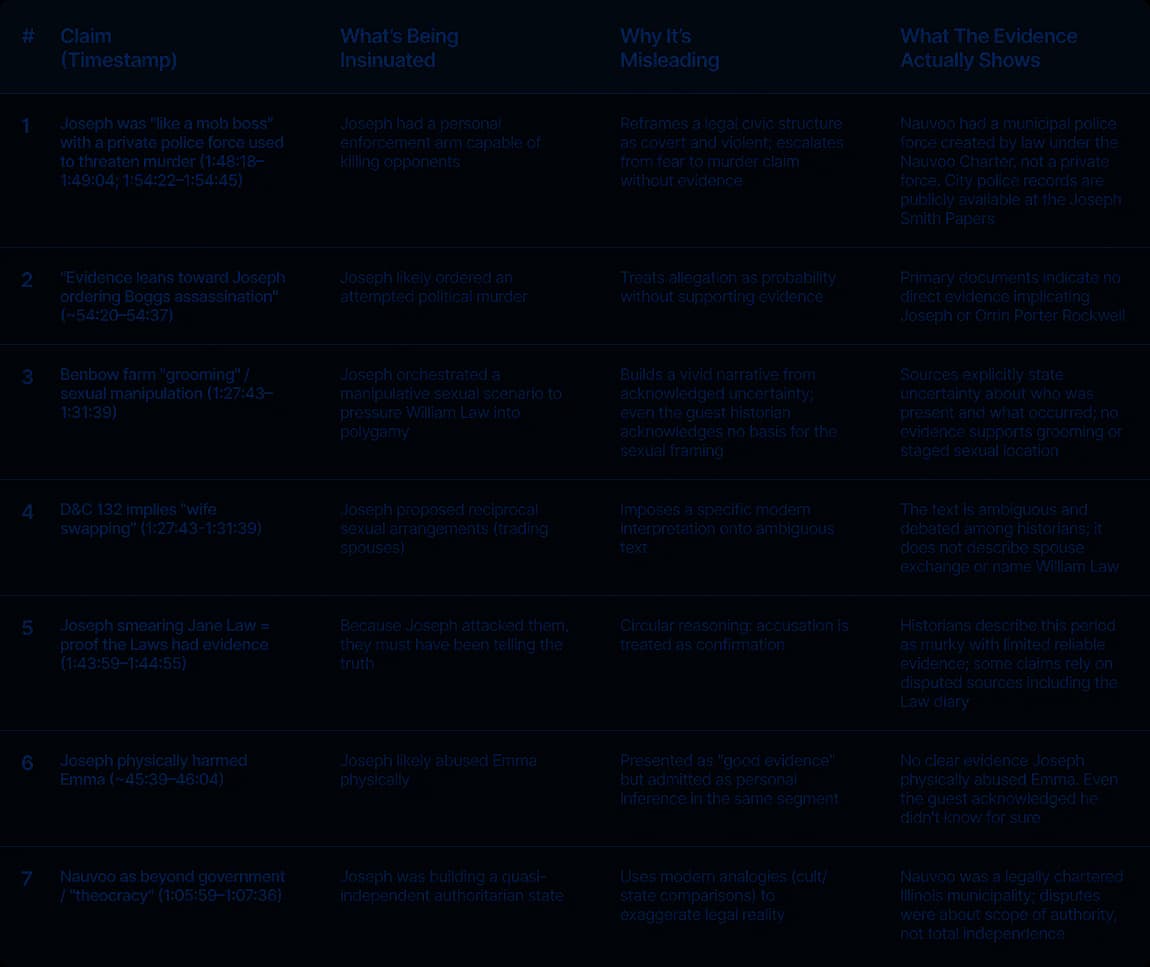
The pattern across this single episode is instructive. The historian Turner, an academic whose book is respected in the field, is repeatedly present with measured, context-dependent framing. The host presses toward the most prosecutorial reading available in each case. A listener who doesn’t stop to check the primary sources — and most listeners will not — comes away believing that Joseph Smith was, in sequence: a mob boss, a probable murderer, a sexual manipulator, a wife-swapper, a smear campaigner, a domestic abuser, and a theocratic dictator. That cumulative portrait is not what John Turner’s book concludes. It is what the editorial cumulative of the episode implies.
Episode 2136 — “Graduated BYU and Resigned Immediately”
This episode featured a recent BYU graduate describing why he left the Church. Unlike the Turner episode, there is no historian on the microphone to contextualize claims. The cumulative effect is more direct, and some of the claims are demonstrably false rather than merely misleading.

The fifth claim in this table is worth stopping on. “If you stop going to church, you get kicked out of BYU” is not a matter of framing. It is a factual statement about BYU’s policy. The actual policy is that students need an ecclesiastical endorsement to remain enrolled, and that the loss of an endorsement prevents them from registering for future classes or graduating. That is a significant consequence — but it is not “kicked out.” The distinction matters because it tells a young listener who is wavering in their belief two very different stories about their options. In one version, their education is over. In the other, they have a process to work through with a bishop. One version is catastrophizing. The other version is the policy as written. The host did not correct the record. The claim aired, uncontested, to a channel with hundreds of thousands of subscribers.
Episode 2135 — “Joseph Smith Introduces the Second Anointing”
With historian John Turner again, Dehlin discussed the introduction of the second anointing ordinance in 1843. Turner offered theological and historical nuance. Dehlin pressed toward a frame in which the ordinance functioned as a mechanism for elite control.
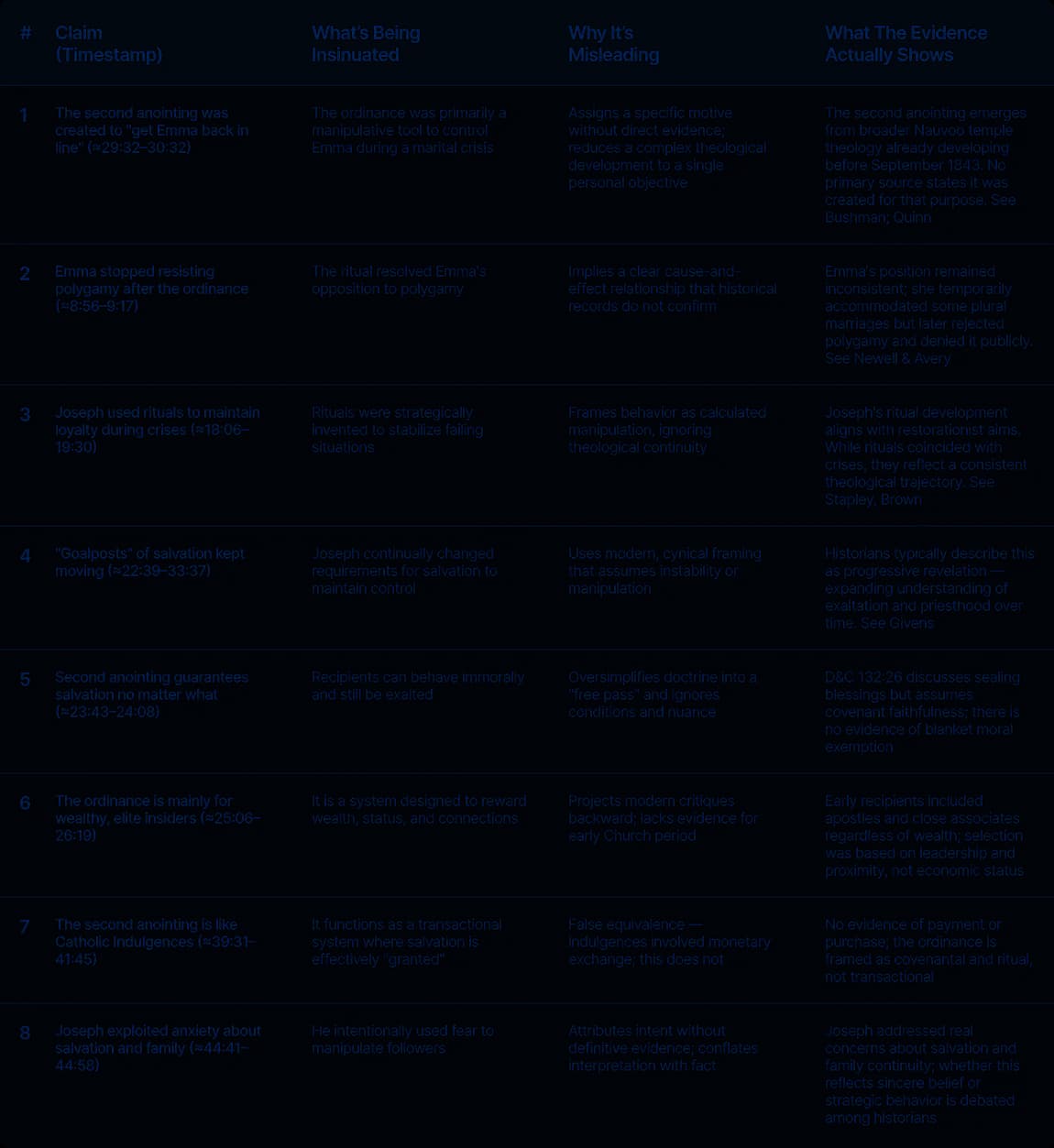
Twenty-two claims. Three episodes. Roughly seven to eight hours of content. The pattern is visible without effort once you know to look for it.
The Pattern Extends Beyond These Three Episodes
It would be easy to object that we selected unrepresentative episodes. We did not. We picked three recent episodes covering three different topics — a historical episode on Joseph Smith’s final months, a contemporary episode on a modern BYU graduate, and a theological episode on a specific ordinance. They were not selected for producing rich tables. The rich tables produced themselves once we started watching.
Similar patterns repeat across other episodes. The podcast’s multi-part LDS Discussions series, which runs parallel to the main Mormon Stories feed and is hosted on the same channel, regularly advances historical claims as settled fact that are, in reality, contested or specifically rebutted by primary sources. The 2023 episode on Richard Bushman’s translation research is one example: it was promoted under a headline claiming that a top Mormon historian had “admitted” the validity of a criticism of the Church, when Bushman’s actual position is substantially more complex than that framing suggests. The 2014 “Questions and Answers” document Dehlin briefly posted on the Mormon Stories website — which characterized the Book of Mormon and the Book of Abraham as fiction, and which catalogued specific factual claims about Joseph Smith’s marriages and behavior — has been publicly rebutted line by line by faithful historians, with links to primary sources, for more than a decade.
The point of surveying beyond the three tables is not to create a longer list of accusations. The point is to establish that the pattern is the product, not the accident. Across twenty years of episodes, across dozens of guests, across history and theology and modern policy alike, the same editorial posture recurs: the least generous interpretation, presented with confidence, with the pushback either absent or visibly underweighted.
That is the formula. It does not require every claim to be false. It only requires that the cumulative portrait be unbalanced in one direction.
Key Takeaway – Part III
Twenty-two documented claims across three episodes. Every claim timestamped, every rebuttal sourced against primary documents. This is not sample bias — the same editorial posture repeats across hundreds of other episodes. The question is not whether Mormon Stories is critical of the Church. The question is whether its portrayals are accurate. The evidence, in three recent episodes alone, suggests that often they are not.
Mormon Stories Finances — What the IRS Form 990s Actually Show
The Open Stories Foundation is a 501(c)(3) public charity. That status comes with a benefit — tax-exempt donations — and an obligation — annual Form 990 disclosures available to anyone with an internet connection. We walk through those disclosures here because they are public, because the same disclosure standard applies to Mormonism Explained and every other nonprofit in this space, and because they tell a story that matches the editorial pattern described above.
Revenue Growth: 2010 to 2024
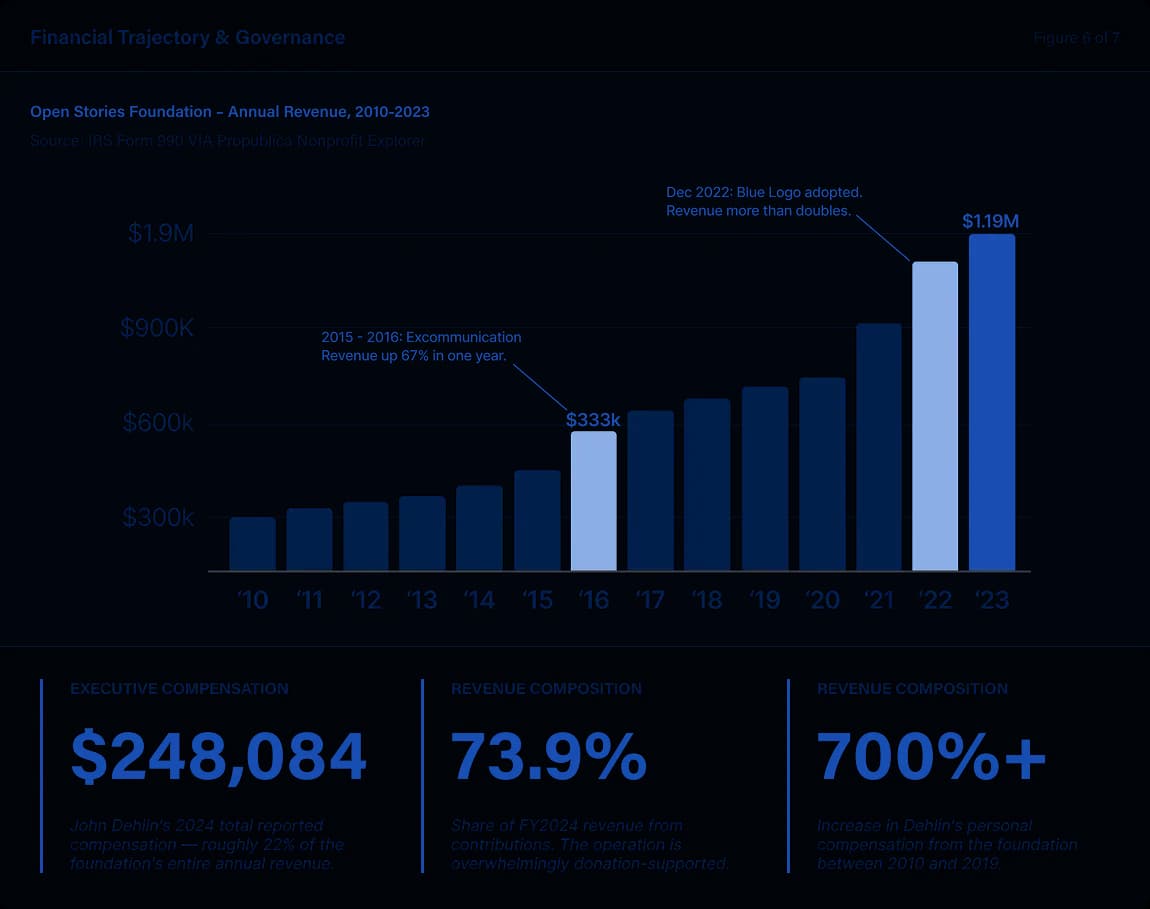
In 2010 — the first year of detailed public reporting — the Open Stories Foundation took in $58,580 in total revenue. By 2019, that figure had grown to $464,339. By 2020, it was $511,117. By 2023, it was $1,192,816. By 2024, the most recent year on file, it was $1,120,862. In fourteen years, the organization grew by a factor of more than nineteen.
The growth was not linear. Two moments visibly accelerated it. The first was Dehlin’s 2015 excommunication. Annual revenue jumped from $198,136 in 2015 to $332,678 in 2016 — a 67 percent increase in a single year, correlated with the public visibility the disciplinary council produced. The second acceleration came with the December 2022 logo rebrand — the visual change the Church’s current complaint targets. Between 2020 and 2024, annual revenue more than doubled.

Key Takeaway
Twenty-two documented claims across three episodes. Every claim timestamped, every rebuttal sourced against primary documents. This is not sample bias — the same editorial posture repeats across hundreds of other episodes. The question is not whether Mormon Stories is critical of the Church. The question is whether its portrayals are accurate. The evidence, in three recent episodes alone, suggests that often they are not.
The composition of that revenue matters. In the 2024 fiscal year, 73.9 percent of total revenue came from contributions. Another 25.9 percent came from program service revenue. The organization is overwhelmingly donation-supported — which, in practice, means it is listener-supported. Every new person pulled into the audience is a potential recurring contributor through Patreon, PayPal, Venmo, Donorbox, and the podcast’s various other fundraising channels.
John Dehlin’s Compensation
John Dehlin is the executive director of the Open Stories Foundation. His total reported compensation for fiscal year 2024 was $248,084 — a combination of $220,320 in salary and $27,764 in other reportable compensation. His 2023 total was approximately $255,323. His 2019 total was $236,021, which at the time represented roughly 60 percent of the organization’s entire revenue. In 2024, with the organization larger, his compensation represented roughly 22 percent of revenue — still a significant share for any public charity, but proportionally smaller than in years past. Executive compensation at a nonprofit is not, in itself, a scandal. Many nonprofit leaders earn salaries in this range. Every 501(c)(3) is required to set executive pay based on market comparables, document the process, and have it reviewed by an independent committee. But the Dehlin compensation figures invite scrutiny because of a different document in the public record: a 2021 whistleblower complaint filed with the Internal Revenue Service by a former associate producer at the Open Stories Foundation.
The 2021 IRS Whistleblower Complaint
In 2021, James Patterson — a former associate producer at Mormon Stories — filed a whistleblower complaint with the IRS against the Open Stories Foundation. The complaint, which was later obtained and reported on by the Salt Lake Tribune in February 2022, alleged two central concerns.
The first was that Dehlin had, in Patterson’s characterization, curated the composition of the Open Stories Foundation’s board of directors in ways that maximized his own compensation while minimizing independent oversight. The complaint alleged a pattern in which board membership was selected for loyalty rather than arm’s-length governance, and in which executive compensation reviews did not function as the check that nonprofit governance law contemplates. Patterson’s summary phrasing, reproduced in the Tribune coverage, was that Dehlin treated the foundation as his own, with an independent board functioning as a roadblock rather than a check.
The second allegation concerned the commingling of funds between the Open Stories Foundation and Dehlin’s personal life-coaching business. Patterson alleged that the boundaries between podcast donations and Dehlin’s private commercial activities were inadequate — a common allegation pattern in nonprofit disputes, and one that, if substantiated, would raise serious questions under private-inurement rules that prohibit nonprofits from enriching insiders.
Dehlin publicly denied the allegations, stated that his compensation had been set based on market comparables and external analysis, and pointed to what he described as a favorable Utah Department of Commerce audit. When the Salt Lake Tribune submitted an open-records request for that audit, the Utah Attorney General’s office reported it had no record of it. The Utah Department of Commerce, which oversees nonprofits, would neither confirm nor deny that it had conducted such a review, citing the standard policy that investigative records involving nonprofits are not public when they exist.
The 2021 complaint has not — to our knowledge, based on publicly available records — resulted in a public IRS action. That fact can be read two ways. It can be read as evidence that the IRS reviewed the complaint and found it without merit, in which case the allegations are just allegations. It can also be read as reflecting the IRS’s well-known limited capacity to investigate small and mid-sized 501(c)(3) organizations, which process millions of filings annually with a fraction of the enforcement staff their mandate requires. We do not know which reading is correct, and we do not claim to.
What we can say is this: the whistleblower complaint is a matter of public record. Its substance was reported in a major metropolitan newspaper. The financial growth trajectory of the organization is visible in the 990s. The governance concerns it raised have not been publicly resolved. And those facts are relevant to readers assessing where the money behind this twenty-year media operation actually goes.
The Business Model in One Sentence
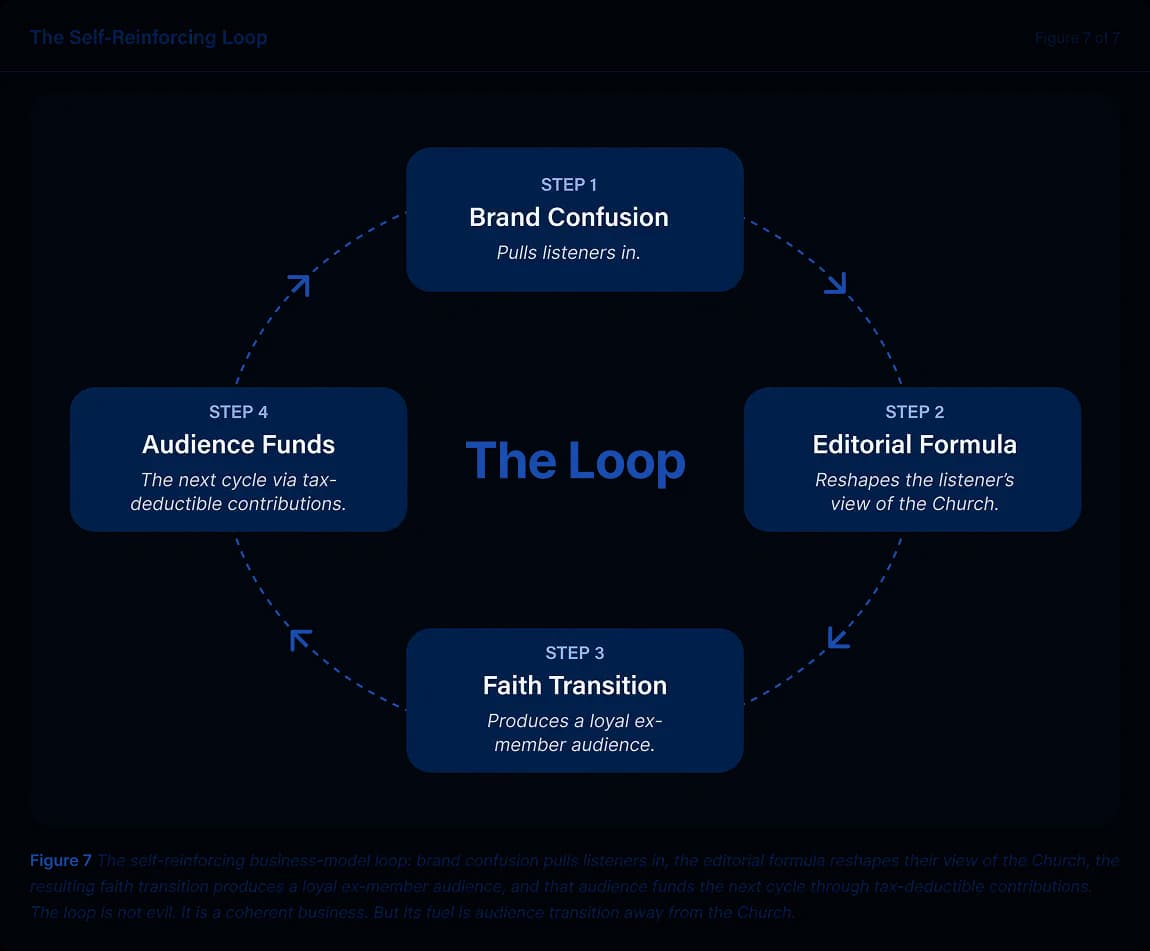
Here is the model as cleanly as we can state it: branding choices that blur the line between Mormon Stories and the Church pull in new listeners. Listeners are presented with editorially unbalanced content that consistently leads toward one conclusion. That conclusion generates a community of former members who remain emotionally invested in the show. That community supports the show financially through tax-deductible contributions. Those contributions fund the next cycle of content, which pulls in the next cohort of listeners.
The loop is not evil. It is a coherent business. But it is not a neutral exploration of Mormon issues. It is an engine, and the fuel it runs on is audience transition away from the Church.
Key Takeaway
A podcast that began in 2005 as a mission to keep people in the Church is now a seven-figure nonprofit that generates revenue from the people who leave it. That is the engine. That is what the rebranded logo is actually drawing new listeners into.
The Human Cost — How Mormon Stories Affects Families
Numbers alone understate the story. Every line in a Form 990 corresponds to a family somewhere. Every point of audience growth corresponds to a spouse who began listening, an adult child who lost their testimony, a temple recommend that lapsed, a sacrament meeting that became an argument.
We want to be careful here, because the territory is genuinely contested. Many Mormon Stories listeners credit the show with helping them through difficult periods. On the podcast’s own website, a long thread exists of listener testimonials describing exactly that experience — marriages saved, isolation ended, mental health improved. Those testimonials are real, and we take them seriously. For every listener who credits the show with helping them, however, there are listeners elsewhere — less likely to post on a Mormon Stories comment thread — who describe a different arc. A spouse who began as a curious listener and ended as someone who filed for divorce. A returned missionary who stopped attending within a year of first hitting play. An extended family whose holiday gatherings now skip the prayer because one member considers it indoctrination. A parent who stopped speaking to a child about faith because the child now frames that faith as a control mechanism.
These stories exist in large numbers. They are discussed quietly, in ward councils and bishop’s offices and family text threads, across the Church. They rarely reach the threshold of a published testimonial because the people experiencing them are not, by and large, the people posting on podcast comment boards. But the bishops we have spoken to in researching this piece describe Mormon Stories appearing in faith-transition conversations with members at frequencies that dwarf any other single factor. It is the podcast people are listening to when they stop coming. It is the voice in the room when a family fractures.
We are not claiming — and we want to be especially clear on this — that Mormon Stories is the cause of faith transitions. Faith transitions have many causes, most of them deeply personal, many of them involving real pain that predates the listener’s first episode. A podcast does not create a crisis. But a podcast can shape where a person in crisis arrives. And the editorial formula described above is specifically shaped to make a particular arrival point feel inevitable.
The listener testimonial that has stuck with us most clearly, from the research for this piece, came from an anonymous reader who described being a fifth generation Latter-day Saint convert from South Korea who served a mission, married in the temple, attended BYU, and loved the Gospel — and who described Mormon Stories as the vehicle that, over a period of months, carried them through a sequence of reframes they never would have arrived at on their own. Not because any specific claim in any specific episode was uniquely persuasive. Because the cumulative posture of the show, consumed day after day for a year, rewrote their instincts about what the Church was.
That is the human cost. It is distributed across thousands of households. It rarely shows up in a comment thread. But it is the actual product of the formula.
Key Takeaway – Part V
Mormon Stories does not cause faith transitions. But for many Latter-day Saints, it is the voice in the room when a family fractures. The formula does not just produce statistical imbalance — it produces divorced spouses, alienated adult children, and Christmas dinners that skip the prayer.
The Strongest Defense of John Dehlin — Answered
We want to close this section by taking seriously the strongest defense a reader might offer on Dehlin’s behalf, because an investigation that does not engage the opposing case fails its own readers. Here is what we think the best version of that defense looks like:
“Dehlin is not running a grift. He sincerely believes what he says. He believes the Church’s truth claims are false, he believes members are being harmed by those claims, and he believes he is helping people who are suffering. The financial growth of the podcast does not prove his motives are financial — it proves the audience he serves is real. The branding similarities are accidents of design in a space where the visual vocabulary is inherently Mormon. The lawsuit is a large institution using its resources to silence a smaller critic. And Austin Fife’s ‘formula’ is just what it looks like when a critical podcast does its job: centering the stories the Church refuses to center. If the cumulative picture is unbalanced toward departure, that is because the balance is correcting for a lifetime of imbalance in the other direction.”
That is, in our judgment, the honest version of the best defense. And parts of it are true. Dehlin very likely does sincerely believe what he is saying. The audience is real. Many guests have painful stories that Church discourse has historically underweighted. The visual vocabulary of Mormonism is shared vocabulary, and not every similarity is a calculated infringement.
But belief does not neutralize effect. A sincere guide who leads a hiker off a cliff is not less responsible because they sincerely believed the path was safe. A podcast can be exactly what its host believes it to be — a good-faith space for exploration — and still produce, by virtue of its editorial structure, a one-directional outcome for its listeners. The question is not whether Dehlin is a fraud. The question is whether the machine he has built, regardless of his intent, consistently misrepresents the Church in ways that would survive peer review.
The answer to that question, based on twenty-two documented claims across three recent episodes, is no. The machine misrepresents. The formula is not balanced. The cumulative picture is not fair to the institution it purports to explore. And the federal trademark complaint, for all that it is about logos and photography and light rays, is also a statement by the Church that it has grown tired of being misrepresented by an operation that looks, at a glance, like it is the Church itself.
A disclaimer would have gone a long way. A disclaimer was refused.
Key Takeaway – Part VI
Belief does not neutralize effect. A sincere guide who leads a hiker off a cliff is not less responsible because they sincerely believed the path was safe. The question is not whether John Dehlin is a fraud. The question is whether the machine he has built consistently misrepresents the Church in ways that would survive peer review. On the documented evidence, it does not.
What This Investigation Is — and Is Not
This investigation is not an argument that criticism of the Church should be silenced. It is not an argument that Mormon Stories should be shut down. It is not an argument that former members are wrong or that their stories should not be told. The Church itself, in both the lawsuit and its April 2026 newsroom statement, has been explicit that it is not seeking to limit the podcast’s content. It is seeking to prevent people who are looking for the Church from ending up somewhere else without knowing they have.
What we are arguing is that readers — seekers, members, former members, and curious outsiders alike — deserve accurate framing when they evaluate claims about the Church. A podcast that calls itself Mormon Stories, dresses itself in the Church’s visual language, and presents itself through a formula designed to move audiences in one direction, is not a neutral source. It is a twenty-year project with a clear editorial posture and a seven-figure financial incentive to maintain that posture.
If you are an active Latter-day Saint reading this: do not react by avoiding the podcast. Listen, if you are willing. But listen the way you would read any source with a known editorial posture — with the formula in mind, with the primary sources at hand, and with a readiness to verify.
If you are a former Latter-day Saint reading this: we are not asking you to return. We are asking you to consider whether the cumulative portrait you carry of the Church was assembled through a balanced process or through the repeated application of a specific editorial pattern. That question is worth asking regardless of where you land.
If you are a seeker reading this, looking for objective information about the Latter-day Saint faith: we humbly suggest that the podcast whose logo looks like the Church’s logo is not a neutral starting place. Start with primary sources. Read the Gospel Topics Essays. Read Richard Bushman’s Rough Stone Rolling. Read Patrick Mason’s Planted. Read critical voices too — but read them with awareness of the structures that produce them.
Truth is rarely found at the edges of a spectrum. It is never found by listening to only one source.
Frequently Asked Questions About Mormon Stories and John Dehlin
Is the Mormon Stories podcast affiliated with the LDS Church?
No. The Mormon Stories podcast is not affiliated with or endorsed by The Church of Jesus Christ of Latter-day Saints. It is produced by the Open Stories Foundation, a 501(c)(3) nonprofit founded by John Dehlin, who was excommunicated from the Church in 2015. The Church filed a federal trademark and copyright lawsuit against the podcast on April 17, 2026, alleging that its branding has created public confusion about source and affiliation.
Why did the LDS Church sue Mormon Stories?
The Church of Jesus Christ of Latter-day Saints sued the Open Stories Foundation and John Dehlin on April 17, 2026, for trademark infringement, false designation of origin under the Lanham Act, Utah state trademark infringement, and copyright infringement. The complaint alleges that Mormon Stories adopted a blue logo in December 2022 with light-rays design elements that mirror the Church’s official branding, and that the podcast used Church-owned copyrighted photography without permission. The Church had previously requested a simple disclaimer at the start of each episode acknowledging that Mormon Stories is not affiliated with the Church. Dehlin refused. Mediation failed in March 2026. The case is docketed as 2:26-cv-00321.
Who is John Dehlin?
John P. Dehlin is an American podcaster and the founder of the Mormon Stories podcast. Raised as a fifth-generation Latter-day Saint in Katy, Texas, he served a mission in Guatemala, graduated from Brigham Young University in 1993, and founded Mormon Stories in 2005 with the stated mission of giving Latter-day Saints reasons to remain in the Church. He stopped attending Church in 2011, publicly rejected the Church’s truth claims in 2014, and was excommunicated in January 2015. He holds a PhD in clinical and counseling psychology from Utah State University. He currently serves as Executive Director of the Open Stories Foundation.
When was John Dehlin excommunicated?
John Dehlin was excommunicated from The Church of Jesus Christ of Latter-day Saints on February 8, 2015, after a disciplinary council convened by his local stake president in North Logan, Utah. The official grounds cited in the stake president’s letter were teachings disputing the nature of God and Jesus Christ, statements characterizing the Book of Mormon and Book of Abraham as fraudulent, and statements rejecting the Church as the true Church with authority from God. Dehlin publicly framed the excommunication as related to his views on same-sex marriage and female ordination; the Church issued a correction noting those topics were not cited in the council’s stated reasons.
How much money does Mormon Stories make?
The Open Stories Foundation, which operates the Mormon Stories podcast, reported total revenue of $1,120,862 for fiscal year 2024 and $1,192,816 for fiscal year 2023, according to IRS Form 990 filings available through ProPublica’s Nonprofit Explorer. Approximately 73.9 percent of 2024 revenue came from contributions (donations), with the remainder from program-service revenue. The organization’s revenue has grown roughly nineteen-fold since 2010, with two specific inflection points: a 67 percent single-year jump after Dehlin’s 2015 excommunication, and a doubling between 2020 and 2024 following a December 2022 logo rebrand.
What is John Dehlin’s salary at Mormon Stories?
John Dehlin’s total reported compensation from the Open Stories Foundation for fiscal year 2024 was $248,084, consisting of $220,320 in salary and $27,764 in other reportable compensation, according to the organization’s IRS Form 990. His 2023 compensation was approximately $255,323. In 2024, his compensation represented about 22 percent of the organization’s total revenue. His compensation grew more than 700 percent between 2010 and 2019.
Was there an IRS whistleblower complaint against Mormon Stories?
Yes. In 2021, James Patterson, a former associate producer at the Open Stories Foundation, filed a whistleblower complaint with the Internal Revenue Service. The Salt Lake Tribune reported on the complaint in February 2022. Patterson alleged that Dehlin had curated the composition of the foundation’s board of directors in ways that maximized his own compensation while minimizing independent oversight, and that the boundaries between podcast donations and Dehlin’s personal life-coaching business were inadequate. Dehlin denied the allegations. The IRS has not publicly acted on the complaint. When the Salt Lake Tribune sought records of a state audit Dehlin referenced, the Utah Attorney General’s office reported having no such record.
Is Mormon Stories biased against the LDS Church?
The Mormon Stories podcast is hosted by an excommunicated former Latter-day Saint who has publicly stated that the Book of Mormon and Book of Abraham are works of fiction. The show’s editorial posture is substantially critical of the Church’s truth claims, leadership, and institutional practices. In an analysis of three recent episodes, we documented 22 claims that were misleading, overstated, or demonstrably false when measured against primary sources. Whether the cumulative portrait the podcast presents is balanced is a matter readers must evaluate for themselves; the evidence suggests it is not.
What is the Open Stories Foundation?
The Open Stories Foundation is a 501(c)(3) nonprofit organization founded by John Dehlin in 2010 to operate the Mormon Stories podcast and related projects. Its stated mission is supporting Mormons and members of other high-demand religions who are experiencing religious transitions. As a public charity, the foundation’s annual Form 990 tax filings are publicly available through the IRS and ProPublica Nonprofit Explorer. In fiscal year 2024, the foundation reported $1,120,862 in total revenue. Dehlin serves as its Executive Director.
How many subscribers does Mormon Stories have?
As of April 2026, the Mormon Stories YouTube channel has approximately 304,000 subscribers and has published more than 2,400 videos since its launch in 2005. The podcast is the most-subscribed exLatter-day Saint media platform. The Open Stories Foundation also publishes two sister podcasts, Mormon Matters and Mormon Mental Health.
Does the LDS Church own the trademark for the word “Mormon”?
The Church of Jesus Christ of Latter-day Saints holds several federally registered trademarks incorporating the word Mormon, including MORMON, BOOK OF MORMON, MORMON TABERNACLE CHOIR, and MORMON CHANNEL. The Church does not hold an exclusive trademark on the standalone word Mormon as a general descriptor, but it has enforced trademark rights in specific commercial and branding contexts. The April 2026 lawsuit against Mormon Stories is not fundamentally about the word Mormon in a podcast name; it is about a cluster of branding choices — including a blue logo, light-rays design, arched frame, typography, and use of Church-copyrighted photography — that the Church alleges creates public confusion about source and affiliation.
What is the Mormon Stories editorial formula?
The Mormon Stories editorial formula, as described by Austin Fife in his book The Light and Truth Letter, follows a consistent five-step pattern across episodes: (1) the host builds trust through warm, empathetic framing; (2) each episode centers a deeply painful personal story with no balancing counterweight; (3) individual grievances are generalized into systemic claims about the Church; (4) positive aspects of Church life are reframed as instruments of manipulation or control; and (5) the listener reaches the conclusion that the Church is the problem as if they arrived at it independently. The formula does not require individual claims to be false to produce a misleading cumulative portrait.
When did Mormon Stories change its logo?
Mormon Stories changed its logo from brown to blue in December 2022, adopting an arched frame with a light-rays design and a centered figure. Contemporaneous comments on the Mormon Stories Facebook page noted the resemblance to LDS Church branding. In November 2025, the Church’s Intellectual Property office contacted Mormon Stories about the branding overlap. After receiving that letter, the podcast changed the logo color to orange and modified its style, but refused to include a verbal or written disclaimer at the start of episodes acknowledging non-affiliation with the Church. The Church filed suit on April 17, 2026.
Did John Dehlin refuse a disclaimer?
Yes. According to the April 2026 federal complaint filed by the Church of Jesus Christ of Latter-day Saints, Dehlin and the Open Stories Foundation refused to include a disclaimer at the beginning of podcast episodes, either verbally or in writing, acknowledging that Mormon Stories is not affiliated with the Church. The Church’s broader proposal included other concessions; Dehlin agreed to some changes, including adding a disclaimer to podcast descriptions on platforms like Apple and Spotify. The specific refusal at issue was an opening-of-episode disclaimer, which the Church considered necessary to address consumer confusion and which Dehlin publicly characterized as the Church trying to micromanage his organization.
Where can I read the Mormon Stories lawsuit complaint?
The full federal complaint is publicly available through PACER (Public Access to Court Electronic Records) under Case No. 2:26-cv-00321, titled Intellectual Reserve, Inc. and The Church of Jesus Christ of Latter-day Saints v. Open Stories Foundation and John P. Dehlin, filed in the U.S. District Court for the District of Utah on April 17, 2026. CourtListener also maintains a free public copy. The Church has also published a public statement about the lawsuit through its newsroom titled Getting It Right: Clarifying Trademark and Branding Concerns, dated April 19, 2026.
Methodology and Sources
This article draws on the following primary and secondary sources:
The federal complaint in Intellectual Reserve, Inc. and The Church of Jesus Christ of Latter-day Saints v. Open Stories Foundation and John P. Dehlin, Case No. 2:26-cv00321, filed April 17, 2026, in the U.S. District Court for the District of Utah, available via PACER. The Church’s April 19, 2026 newsroom statement titled “Getting It Right: Clarifying Trademark and Branding Concerns.” The Guidelines for Third Party Use and Licensing of Church Trademarks and Copyrights (2023) published by Intellectual Reserve, Inc.
For financial analysis: IRS Form 990 filings for the Open Stories Foundation, fiscal years 2010 through 2024, accessed via ProPublica’s Nonprofit Explorer.
For the 2021 IRS whistleblower complaint and related governance concerns: reporting by the Salt Lake Tribune, Feb. 27, 2022 (David Noyce, “’Mormon Stories’ podcaster John Dehlin makes $236K a year from his nonprofit. Is that too much?”). Primary complaint documents quoted within that coverage.
For Dehlin’s biographical and ecclesiastical history: his publicly available biographical materials, public reporting including NBC News (Feb. 10, 2015), Deseret News (Feb. 10, 2015), NPR (Feb. 1, 2015), and the Salt Lake Tribune (March 12, 2015); the February 2015 statement from the Church’s newsroom; and Dehlin’s own public posts and statements.
For the episode analysis tables: direct listening to Mormon Stories episodes 2135, 2136, and 2137, with claims timestamped to the original broadcast audio; primary source verification against the Joseph Smith Papers, the LDS Gospel Topics Essays, the BYU Honor Code ecclesiastical endorsement policy, and the published works of Richard Bushman, D. Michael Quinn, Jonathan Stapley, Samuel Brown, Linda King Newell, Valeen Tippetts Avery, and Terryl Givens as cited in each row.
For the editorial framework: Austin Fife, The Light and Truth Letter, chapter titled “Manipulation and Fallacies,” published at lightandtruthletter.org.
For the listener-experience accounts: on-the-record public posts on X and Instagram from Cheryl Young Stevenson, Troy Sariah (@BlackBlessed), Ember (@upliftandlift), Luke Hanson (@LukeFHan), Aubrey Laidlaw, and @anticipatingchristsreturn. Posts from the Mormon Stories Facebook profile as reproduced in Exhibit 5 of the federal complaint.
Disclosures. Mormonism Explained is a 501(c)(3) nonprofit (EIN 33-4022618). We hold an active trademark license agreement with Intellectual Reserve, Inc., one of the plaintiffs in the case discussed in this article. The editorial decisions about what to include in this piece, which claims to examine, and which interpretations to present were made independently of the Church’s legal team and independently of Intellectual Reserve. We did not coordinate with Church representatives in the preparation of this article. We did not receive compensation from the Church or any Church-affiliated entity in connection with this investigation. As a nonprofit, our own finances are public record via our annual Form 990 filings on ProPublica Nonprofit Explorer, and we apply the same standard of public disclosure to our own operations that we apply in this piece to others.
Corrections. If a reader believes we have mischaracterized any claim, misquoted any source, or misrepresented any position — including Dehlin’s own — we invite a correction. Please contact us at the address on the site. Substantiated corrections will be made with a visible update note at the top of this article.
Related Investigations from Mormonism Explained
For readers seeking additional context on the topics covered in this investigation, the following pieces from the Mormonism Explained archive provide primary-source-based treatments:
Mormonism Explained is a resource designed to provide objective and factual information about Mormonism, its history, doctrines, and policies. Our team of researchers consults experts and primary sources to present factual information on a variety of topics relevant to the Church of Jesus Christ of Latter-day Saints.