
Last Updated: May 21, 2026
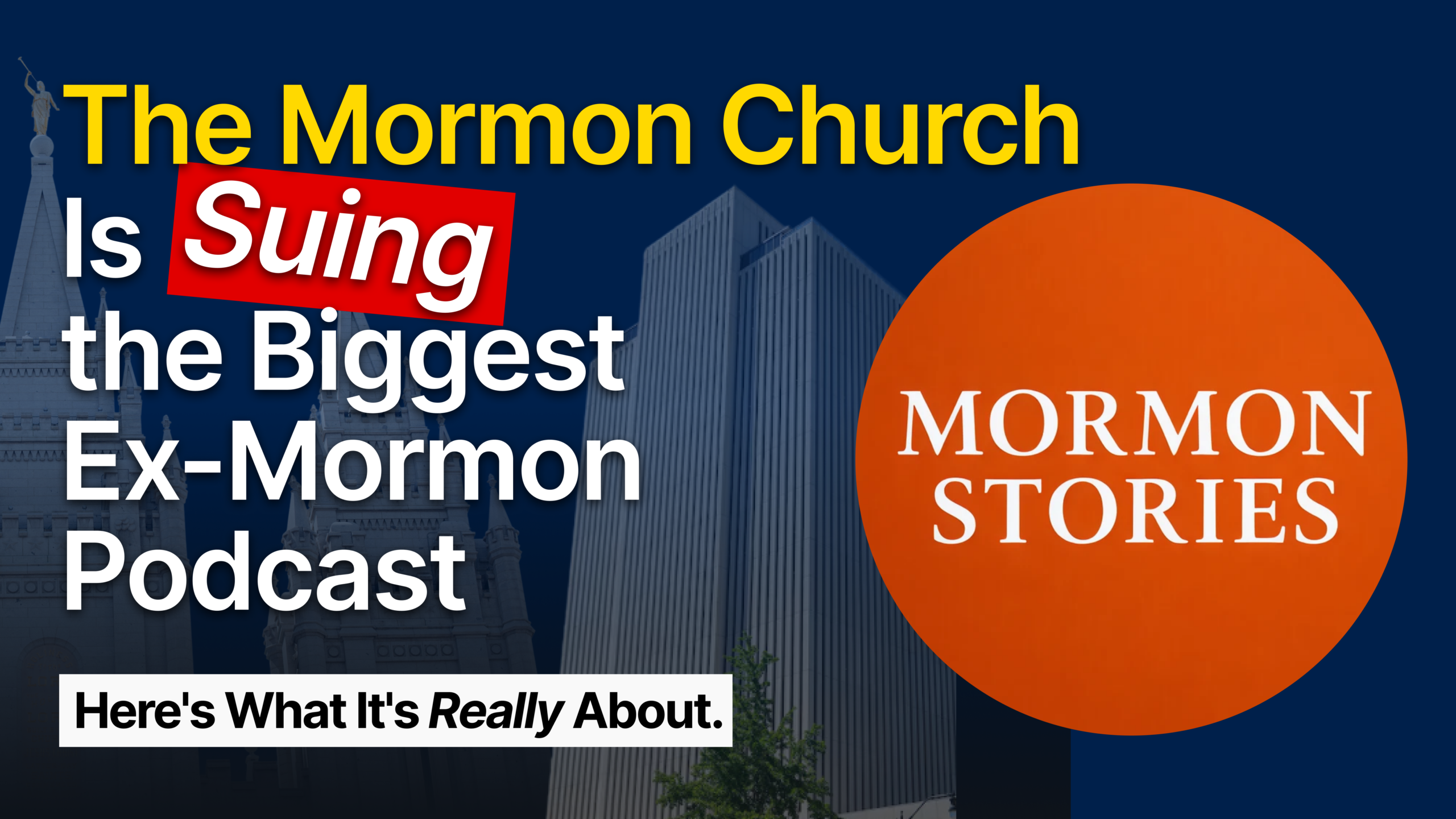
After five months of private negotiation and failed mediation, the Church took its trademark and copyright dispute with one of the largest ex-member platforms in the space to federal court.
Mormonism Explained — April 20, 2026
The Church of Jesus Christ of Latter-day Saints and Intellectual Reserve, Inc. — the Utah nonprofit that holds legal title to the Church’s trademarks and copyrights — filed a trademark and copyright lawsuit against podcaster John Dehlin and his nonprofit, the Open Stories Foundation, in the U.S. District Court for the District of Utah on April 17, 2026. The complaint, docketed as Case No. 2:26-cv-00321, brings four counts: federal trademark infringement, false designation of origin under the Lanham Act, trademark infringement under Utah common and statutory law, and copyright infringement. It alleges that Dehlin’s long-running Mormon Stories podcast has used logos, a blue color palette, a light-rays design motif, and Church-owned photography in ways calculated to cause audiences to believe the program is official or affiliated content when it is not.
Dehlin, who was excommunicated from the Church in 2015, founded Mormon Stories in 2005 and later formed the Open Stories Foundation in 2010 to advance the podcast’s mission. The program’s YouTube channel today has roughly 290,000 subscribers and more than 2,400 videos, making it one of the most widely consumed platforms in the ex–Latter-day Saint online space. Mormon Stories also publishes two sister podcasts, Mormon Matters and Mormon Mental Health.
The Church’s Case
The complaint centers on what the Church describes as a pattern of overlapping branding choices rather than any single element. According to the filing, those elements include the podcast’s blue round logo — which the complaint says Mormon Stories adopted in or around December 2022, replacing an earlier brown version — along with a light-rays design motif, a typographic style reminiscent of Church materials, and unlicensed use of Church-owned photography. The complaint identifies specific instances of that photographic use, including images of Church President Russell M. Nelson, an image of the First Presidency at general conference, the Christus representation, and photographs of temples used in episode thumbnails.
The complaint also alleges a specific breakdown in good faith. After Mormon Stories assured the Church it would remove copyrighted images from its website and social media pages and not use them in the future, the filing states, the podcast used a Church-owned, copyright-registered image of a temple to advertise a Mormon Stories episode “just a few days later.”
In a newsroom post published the same day as the filing, the Church emphasized that the lawsuit is not a response to the podcast’s viewpoint, adding that it respects the right to free expression and has no interest in censoring the show. “This case does not concern the content of the podcast,” the statement reads — framing the dispute instead as one about source confusion and affiliation.
Did John Dehlin intentionally cause brand confusion by naming the podcast ‘Mormon Stories’?
The filing also includes screenshots of comments posted on Mormon Stories’ own Facebook and YouTube pages in which viewers describe having initially mistaken the show for a faithful or Church-produced resource. One commenter, whose name the complaint redacts for privacy, wrote: “I stumbled upon the Mormon Stories podcast, thinking it was church affiliated.” The Church uses these comments to argue that the confusion is not hypothetical.
That argument received additional public amplification in the hours after the filing. Writing on X, Cheryl Young Stevenson described searching for information about the Church before she joined and being led to Mormon Stories. “It looked like a legit broadcast from the Church,” she wrote, adding that the experience left her confused.
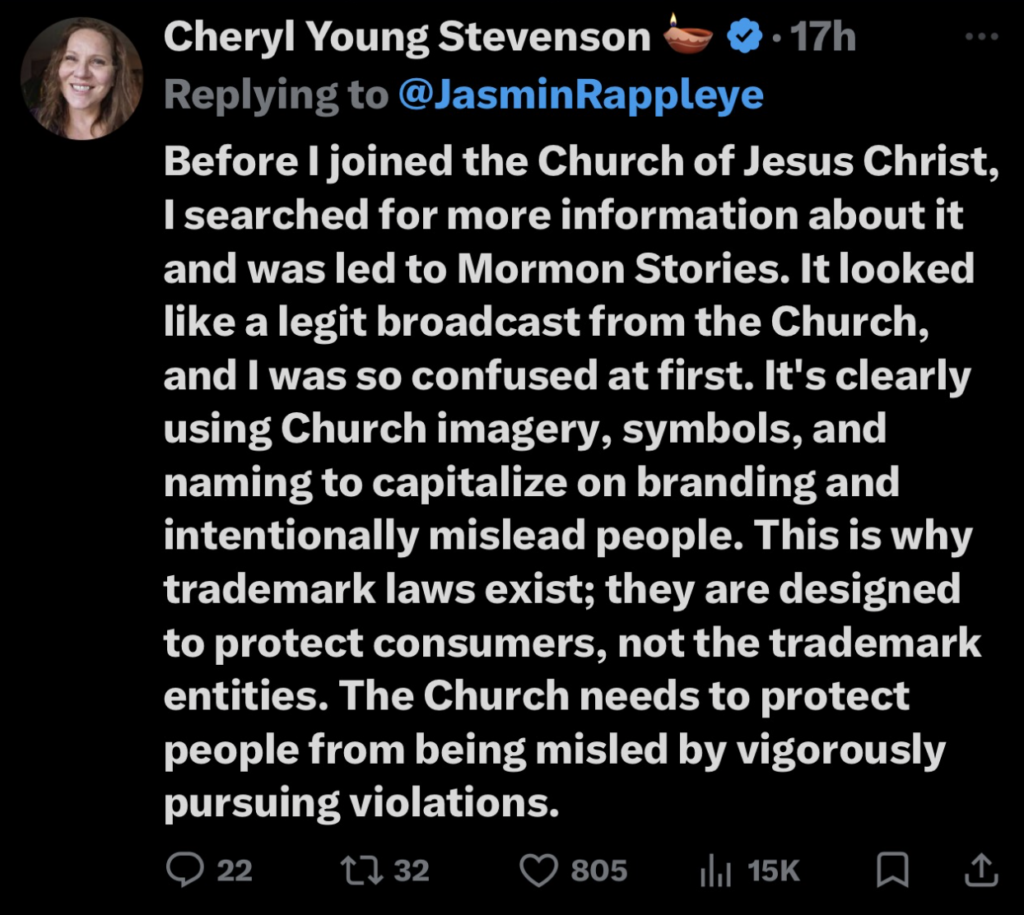
Other Latter-day Saints posting to the same thread shared similar firsthand accounts — including users who said they had encountered Mormon Stories while trying to find official Church podcasts and initially assumed the program was Church-produced. The posts are not evidence in the legal case, but they illustrate the factual claim the Church is making: that the audience confusion cited in the complaint is not abstract.
Which Marks the Church Protects — and How Licensing Works
The Church publishes its framework for third-party use of its intellectual property in a public document titled Guidelines for Third Party Use and Licensing of Church Trademarks and Copyrights. All of the Church’s trademarks, service marks, and copyrights are held and administered by Intellectual Reserve, Inc., a Utah nonprofit corporation affiliated with the Church.
A non-exhaustive list of the Church’s trademarks and service marks includes:
- The Church of Jesus Christ of Latter-day Saints
- The Christus symbol — an image of Christ with outstretched arms standing under an arch
- Liahona
- Book of Mormon
- Mormon
- LDS
- CTR
- FamilySearch
Under the published guidelines, third parties wishing to use those marks are directed to request a license through the Church’s permissions portal. The guidelines state plainly that requests from outside individuals and organizations to use Church marks as primary branding are rarely approved, that such licenses when granted are governed by a written contract, that disclaimers are often required, and that royalties may apply.
Mormonism Explained, a 501(c)(3) nonprofit, has gone through this licensing process. We requested and were granted a standard trademark license agreement with Intellectual Reserve — the same entity that filed the current complaint alongside the Church — covering our use of the words “Mormon” and “Mormonism” in our organization’s name before launching, and we operate within the terms of that agreement today. We note the relationship directly because it is material to the story. It is also one of the reasons we are covering it: the mechanics of Church trademark licensing are not abstract to our organization, and the distinction the Church is drawing in the Mormon Stories complaint — between commentary about the Church and branding that is mistaken for the Church — is the line the licensing process exists to draw.
A Familiar Pattern for Creators
The dispute with Mormon Stories is the largest and most public version of a process that has played out many times over with smaller creators in the Latter-day Saint online space — on both sides of the doctrinal divide.
In 2019, after the Church released its Come, Follow Me home-study curriculum, a wave of independent podcasts, YouTube channels, blogs, and social accounts launched using the same name. Creator Jasmin Rappleye has described how many of those accounts received polite requests from the Church’s legal team to stop using the curriculum title to avoid confusion with official Church content. Several rebranded as a result. The podcast now called Talk of Him, for instance, was previously known as Real Talk–Come, Follow Me. The We Believe Foundation — a 501(c)(3) nonprofit dedicated to helping Latter-day Saints establish a habit of daily scripture study — operated as the Come Follow Me Foundation before rebranding to its current name. Both organizations are openly supportive of the Church, which underscores the neutrality the Church attributes to its enforcement framework: the outreach was not about viewpoint but about reducing confusion between independent content and official curriculum.
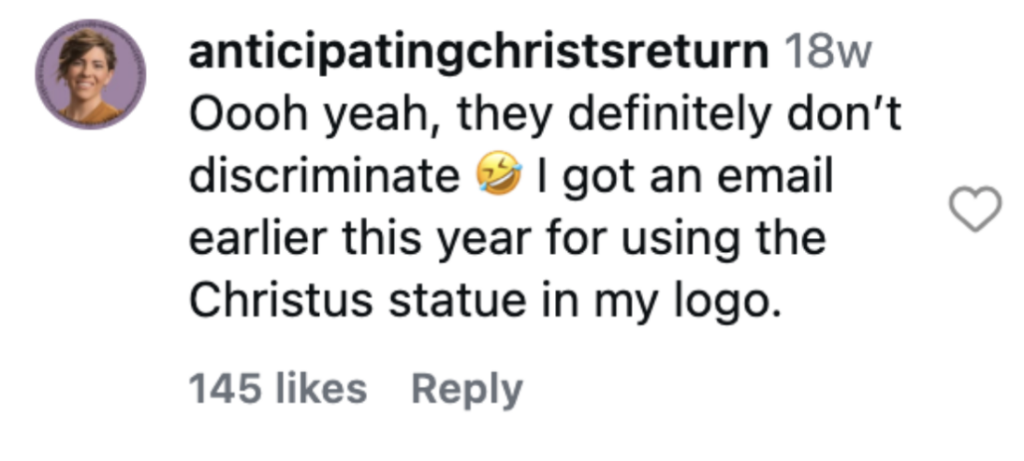
More recent examples extend beyond naming to visual identity. The operator of the Instagram account @anticipatingchristsreturn — a faith-forward page that publishes doctrinal content — commented on the same thread that she was contacted earlier this year after using the Christus statue in her channel’s logo, noting that the Church does not appear to distinguish between supportive and critical creators when the visual line has been crossed.
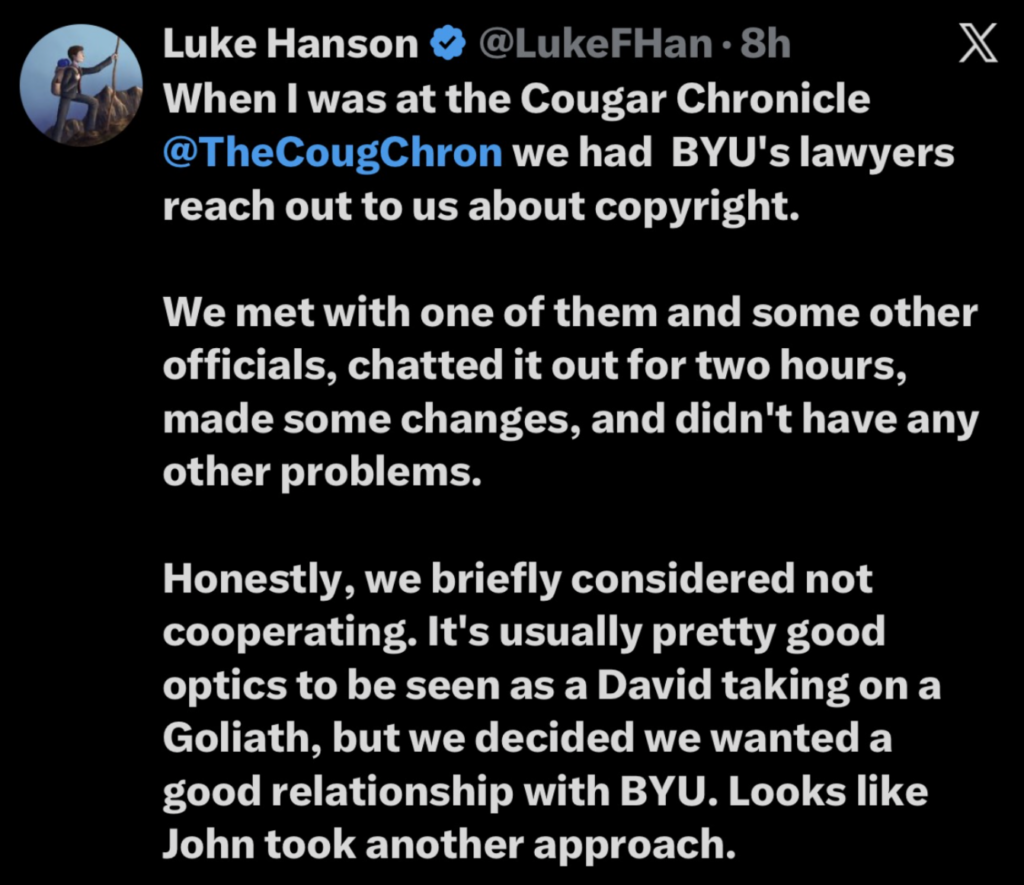
A parallel example surfaced in public response to the Mormon Stories filing. Luke Hanson, a former staffer at Brigham Young University’s student newspaper The Cougar Chronicle, wrote on X that the paper’s team was once contacted by BYU’s lawyers over a copyright concern. The staff met with the university’s counsel for roughly two hours, made requested changes, and had no further issues. Hanson noted that his team had briefly considered declining to cooperate because, in his words, it is usually good optics to be cast as a David against a Goliath — but chose a working relationship with BYU instead.
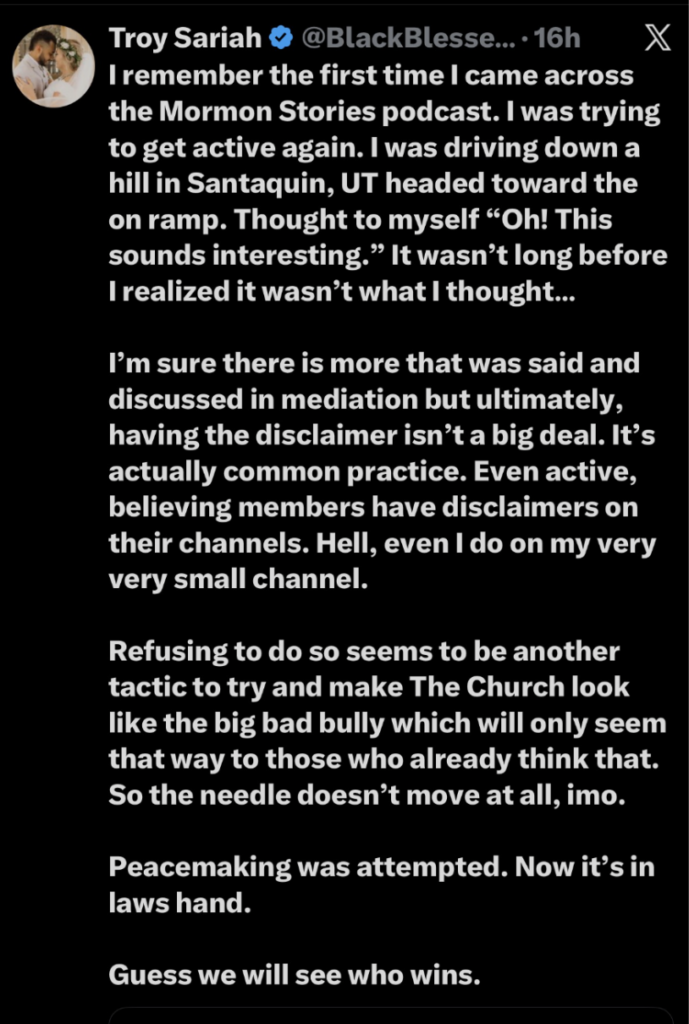
Other Latter-day Saint creators weighed in publicly on the core disclaimer question. Troy Sariah, who maintains a small faith-based channel, wrote that “having the disclaimer isn’t a big deal — it’s actually common practice,” noting that active, believing creators routinely include them on their own platforms.
That broader pattern tracks with the Church’s own public statement that it reviews hundreds of potential trademark matters each year and typically resolves them through private correspondence rather than litigation. It also illustrates a point the Church made in its newsroom post: the enforcement framework applies to supportive and critical creators alike. The Mormon Stories case is distinctive not because the Church objected to content about the Church — it regularly does not — but because, in the Church’s telling, earlier remediation did not achieve the separation it was seeking.
Broader Context
This is not the first time the Church has publicly defended its trademarks in a formal proceeding. In 2023 it filed opposition before the U.S. Patent and Trademark Office against reality television personality Heather Gay’s application to trademark the phrase “Bad Mormon”; Gay withdrew her application in 2024 and the office entered judgment in the Church’s favor.
The Business Behind the Podcast
Because Open Stories Foundation is a 501(c)(3) nonprofit, its finances are a matter of public record. According to IRS Form 990 filings extracted by ProPublica’s Nonprofit Explorer, the organization reported $1,120,862 in revenue for fiscal year 2024 and $1,192,816 in fiscal year 2023. The 2024 mix was 73.9% contributions and 25.9% program-service revenue. Dehlin, listed as executive director, received $220,320 in reported compensation plus $27,764 in other reportable compensation in 2024, for a total of roughly $248,000. His 2023 total was roughly $255,000.
Those figures place Mormon Stories in the category of a seven-figure nonprofit media operation rather than an independent hobbyist podcast. They also reflect sustained growth: the organization reported $511,117 in revenue in 2020 and has more than doubled in the four years since. The Blue MORMON STORIES logo the current complaint targets was adopted in December 2022, during that growth period.
We note these figures because they are part of the public record and because the same disclosure standard applies across 501(c)(3) organizations — including Mormonism Explained. Annual Form 990 filings are how readers, donors, and regulators evaluate any tax-exempt organization, ours and Open Stories Foundation alike.
The Church is asking the court to permanently bar the Open Stories Foundation from using marks and designs it describes as confusingly similar to the Church’s own, and from reproducing, distributing, or publicly displaying Church-copyrighted works — or derivatives of them — when advertising or promoting its content. The complaint requests a jury trial.
Dehlin, for his part, maintains that the Open Stories Foundation has acted in good faith, that the branding adjustments already made address any reasonable concern, and that the podcast’s content and imagery fall within the bounds of fair use and protected expression.
The case now moves to the U.S. District Court of Utah, where the parties will argue the central question of the dispute: whether a two-decade-old independent podcast built around the Mormon name and visual vocabulary has crossed the line from commentary into trademark and copyright infringement — or whether the Church’s effort to police that vocabulary reaches too far.
Sources
Complaint, Intellectual Reserve, Inc. and The Church of Jesus Christ of Latter-day Saints v. Open Stories Foundation and John P. Dehlin, Case No. 2:26-cv-00321, U.S. District Court for the District of Utah, filed April 17, 2026 (publicly available via PACER); Church of Jesus Christ Newsroom, “Getting It Right: Clarifying Trademark and Branding Concerns” (April 19, 2026); Intellectual Reserve, Inc., Guidelines for Third Party Use and Licensing of Church Trademarks and Copyrights (2023); Open Stories Foundation IRS Form 990 filings (fiscal years 2020–2024), via ProPublica Nonprofit Explorer; Deseret News reporting by Tad Walch (April 19, 2026); Mormon Stories / Open Stories Foundation public statements and website; on-the-record public posts on X and Instagram from Cheryl Young Stevenson, Troy Sariah (@BlackBlessed), Luke Hanson (@LukeFHan), Jasmin Rappleye, Aubrey Laidlaw, and @anticipatingchristsreturn. Mormon Stories Podcast, Episode 1678, “Tommy ‘THETOMSTERS’ & Madison Johnson,” Open Stories Foundation, October 25, 2022.
About the author: Todd Noall is Co-Founder and Executive Director of Mormonism Explained, a 501(c)(3) nonprofit dedicated to defending Latter-day Saints and Christians against misinformation and media bias.
About Mormonism Explained
Mormonism Explained is a resource that was designed to provide objective and factual information about Mormonism, its history, doctrines, and policies. Our team of researchers consults experts and primary sources to present factual information on a variety of topics relevant to the Mormon Church.