
Last Updated: May 21, 2026
The longest-running ex–Latter-day Saint podcast is also a seven-figure nonprofit media operation. Here’s what public filings and audience data show about how it works and how it has grown.
Mormonism Explained — April 20, 2026
Mormon Stories, the podcast founded by John Dehlin in 2005, is often described as an independent platform for stories about Mormonism. What its public filings show is something more specific: a seven-figure nonprofit media operation, donor-funded, growing steadily, with a full-time executive director paid competitively for a nonprofit of its size. This article summarizes what is publicly verifiable about that operation, drawing on IRS Form 990 filings extracted by ProPublica’s Nonprofit Explorer and audience data reported by the podcast’s own distribution platforms.
We publish this reference piece because questions about Mormon Stories’ scale and funding come up frequently in the context of the current trademark and copyright lawsuit filed against the podcast and its parent nonprofit. The figures below are not arguments about that case. They are the public record.
The Organization
The corporate home of the Mormon Stories podcast is the Open Stories Foundation, an Arizona 501(c)(3) nonprofit that Dehlin formed in 2010, five years after starting the podcast. According to the organization’s own filings, the foundation’s purpose is to advance the mission of Mormon Stories. It is classified by the IRS under the “Religion-Related, Spiritual Development / Religious Media, Communications Organizations” category. Donations to the foundation are tax-deductible, and the foundation is required by federal law to file an annual Form 990 disclosing its finances.
Revenue and Growth
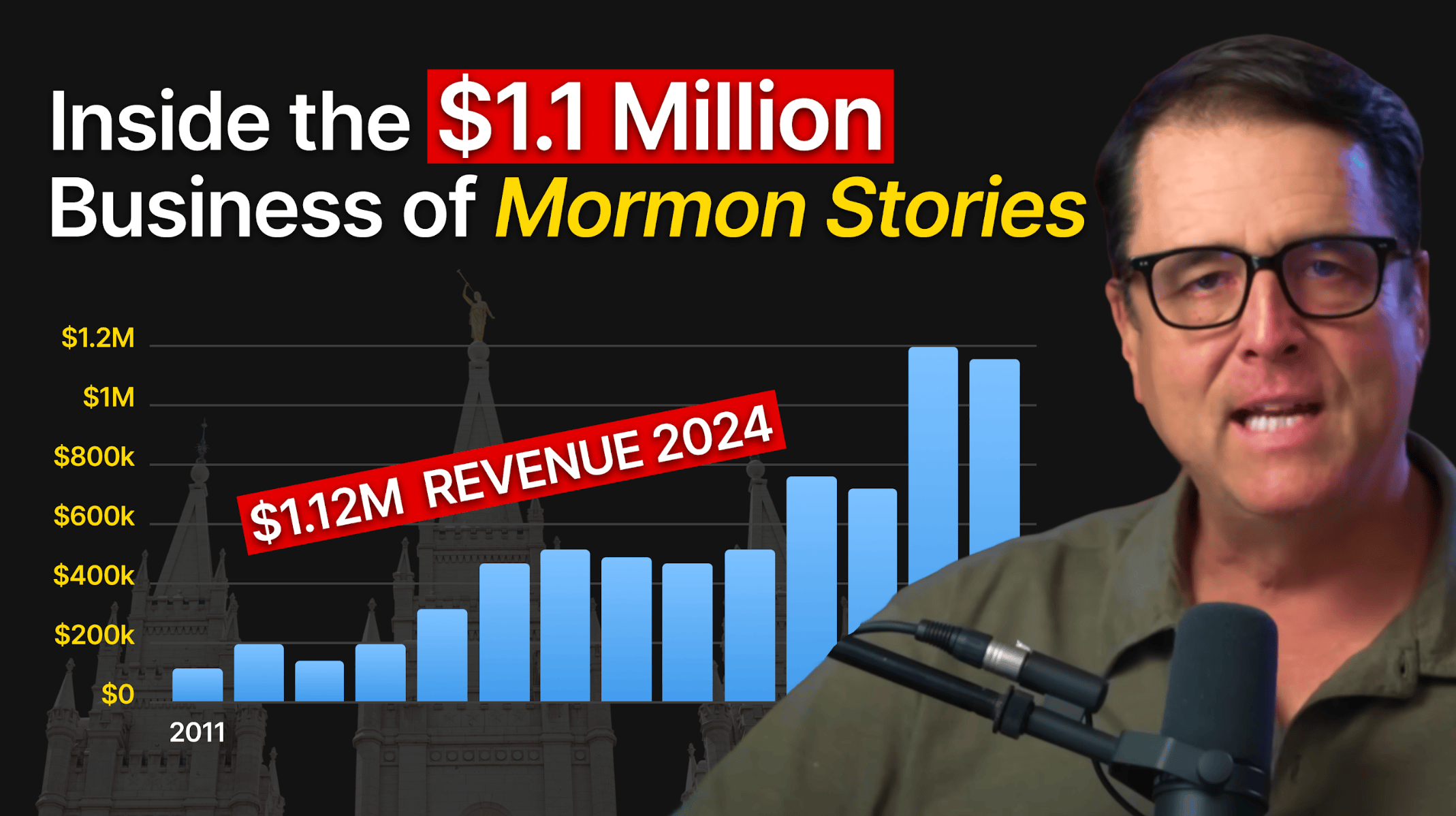
For fiscal year 2024, the Open Stories Foundation reported $1,120,862 in total revenue against $948,986 in expenses. The prior year, 2023, was slightly larger on the top line at $1,192,816 in revenue. Both years place the organization firmly in the seven-figure range for U.S. religious-media nonprofits.
The more striking pattern is the growth trajectory. In 2020, the foundation reported $511,117 in revenue. In 2021, $751,928. In 2022, $738,478. By 2023, it had crossed a million for the first time, and it has held above that line since. In other words, the organization has more than doubled in size over the last four reporting years. The Blue MORMON STORIES logo that is central to the current trademark lawsuit was adopted in or around December 2022, during that growth period.
Where the Money Comes From
The Open Stories Foundation is overwhelmingly donor-funded. In fiscal year 2024, $828,528 of the foundation’s revenue — roughly 73.9% of the total — came from contributions. Another $289,912, or 25.9%, came from program-service revenue, a category that for a media nonprofit typically includes items like paid community memberships, event and retreat fees, and subscription-based content access. A small remainder came from investment income.
The Mormon Stories website and its Apple Podcasts description actively solicit contributions through several channels — Donorbox, PayPal, Patreon, Venmo, and YouTube channel memberships — and describe donations as the primary funding channel that keeps the podcast and its parent foundation running. Patreon alone currently lists 119 paid members at a starting tier of $10 per month, implying a minimum of roughly $14,280 per year in gross Patreon revenue before platform fees.
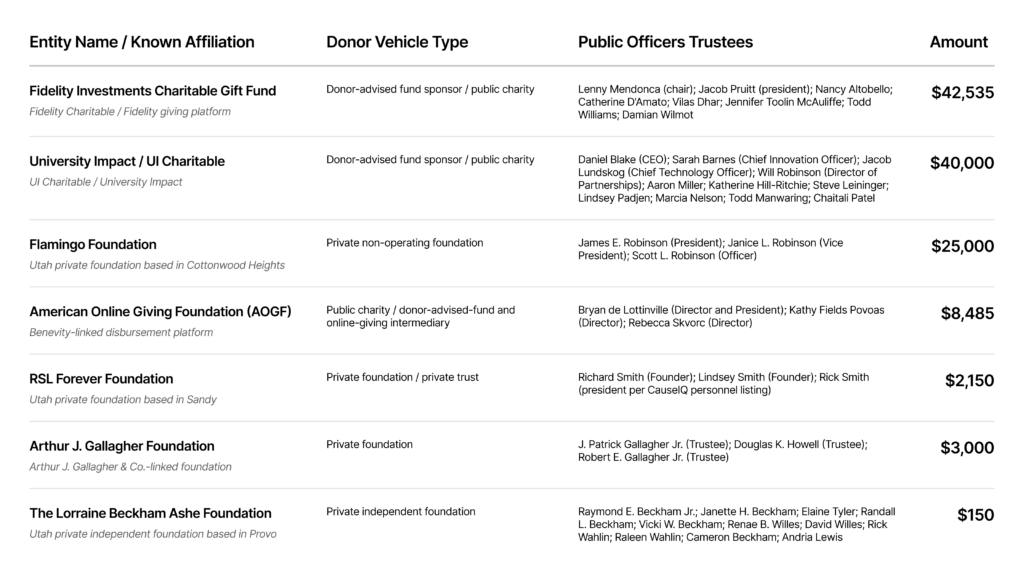
The donor base itself is a mix of individual giving and institutional channels. Public Form 990 filings from grant-making organizations show donations to the foundation have come from both donor-advised fund sponsors — the large intermediary charities that process giving on behalf of anonymous individual donors — and from named private family and corporate foundations, several of them Utah-based. Because donor-advised funds allow individual contributors to remain anonymous, the specific individuals behind the largest institutional grants are not publicly identified in the filings.
Audience and Reach
The Mormon Stories YouTube channel currently has approximately 301,000 subscribers and has accumulated roughly 144.9 million lifetime views. Third-party analytics service vidIQ reports about 1.89 million views on the channel in the last 30 days and estimates current monthly YouTube AdSense earnings at approximately $2,960. Recent episode uploads range from roughly 10,000 to 62,000 views apiece.
On Instagram, the @mormstories account has approximately 101,000 followers. Dehlin’s personal Instagram account, @johndehlin, has approximately 19,000 followers. Apple Podcasts lists Mormon Stories with a 4.5 out of 5 rating from more than 5,500 ratings. The organization’s own website states that its content received more than 45 million views across all platforms in 2023.
Total lifetime podcast listens are not publicly disclosed. Apple, Spotify, and the other major podcast platforms do not expose per-show download counts. The clean publicly verifiable reach number is therefore the YouTube lifetime view count; the actual cross-platform audience is larger, but not precisely measurable from outside the organization.
Executive Compensation
Dehlin is listed on the foundation’s 990 filings as its executive director. For fiscal year 2024, he received $220,320 in reported compensation plus $27,764 in other reportable compensation, for a total of approximately $248,000. His 2023 total was approximately $255,000. His compensation has risen gradually over time — from roughly $96,000 in 2016, his first full year of reported pay, to the current quarter-million range — roughly tracking the growth of the organization itself.
For context, executive compensation at U.S. nonprofits in the $1–5 million annual revenue range typically runs between $150,000 and $300,000 for the top-paid employee, with the higher end more common at media-driven organizations where the executive is the on-camera or on-microphone presence. Dehlin’s compensation sits within that normal band. It is not an outlier, upward or downward, for a nonprofit of this size and type.
The Business Model, Summarized
Putting the pieces together: the Open Stories Foundation is a donor-funded media nonprofit. The majority of its revenue comes from contributions solicited directly from its audience. Platform-native monetization — YouTube ad revenue, Patreon memberships — is present but comparatively small, generating roughly $50,000 per year in visible, verifiable inflow at current scale. Brand sponsorships on YouTube and Instagram represent additional monetization opportunities at the organization’s audience size, but public filings and media kits do not establish what, if any, sponsorship revenue the organization currently books. The dominant economic fact about Mormon Stories is not advertising. It is an audience donation.
That model has implications for how any dispute involving the podcast plays out in public. A donation-funded platform with a loyal audience of several hundred thousand people can convert controversy into engagement, and engagement into contributions, in ways that an ad-supported or subscription-only platform cannot. That is neither a compliment nor a criticism. It is a feature of the business model, one the organization has publicly embraced, and one worth understanding when evaluating any public statement the organization makes about pressure from outside parties.
Sources
Open Stories Foundation IRS Form 990 filings (fiscal years 2011–2024), via ProPublica Nonprofit Explorer (EIN 27-2026793); Mormon Stories Podcast website and Apple Podcasts listing; Mormon Stories Patreon page; YouTube channel analytics via vidIQ and SocialBlade; public Instagram profile data for @mormstories and @johndehlin; Form 990 filings of grantmaking organizations that have contributed to the Open Stories Foundation.
To read the full article about the John Dehlin Mormon Stories Lawsuit, click here.
About the author: Todd Noall is the Co-Founder and Executive Director of Mormonism Explained, a 501(c)(3) nonprofit dedicated to defending Latter-day Saints and Christians against misinformation and media bias.
About Mormonism Explained
Mormonism Explained is a resource that was designed to provide objective and factual information about Mormonism, its history, doctrines, and policies. Our team of researchers consults experts and primary sources to present factual information on a variety of topics relevant to the Mormon Church.