
Mormonism Explained
Ex-Mormons Explained: Who is More Likely to Leave?
Statistical analysis reveals key demographic patterns predicting whether Latter-day Saints leave the Church.
We live in an age where digital technology has changed the way we think, speak, learn, and interact with each other. One could argue that humanity is more intelligent now than ever before, having unlimited, effortless access to information and culture. However, the digital revolution has also driven forward a trend that had already been picking up speed for the last few decades: a gradual and global exodus from organized religion.
The Church of Jesus Christ of Latter-day Saints (often known as the LDS or Mormon Church) represents a minority under the umbrella of Christianity. Traditionally known for their large, close-knit families and high levels of religious devotion, has Mormonism, too, followed the trend of decreasing religiosity?
According to Church membership data, the LDS Church is actually growing, although at a slower rate than it did twenty or so years ago. Outflow from Mormonism explained is balanced out by new converts, with natural growth likely coming from new children being born. Plenty of ex-Mormons exist, so the question arises: what makes an individual more likely to leave the Church of Jesus Christ of Latter-day Saints?
Mormon vs Ex-Mormon Family Life Statistics
Latter-day Saints have a history of being under-represented in surveys on religious activity. However, a Pew Religious Landscape Survey from 2014 had a sufficient sample size from both Mormons and ex-Mormons to derive some correlations from. Stephen Cranney, an area statistician, analyzed and compared the data on these two groups.
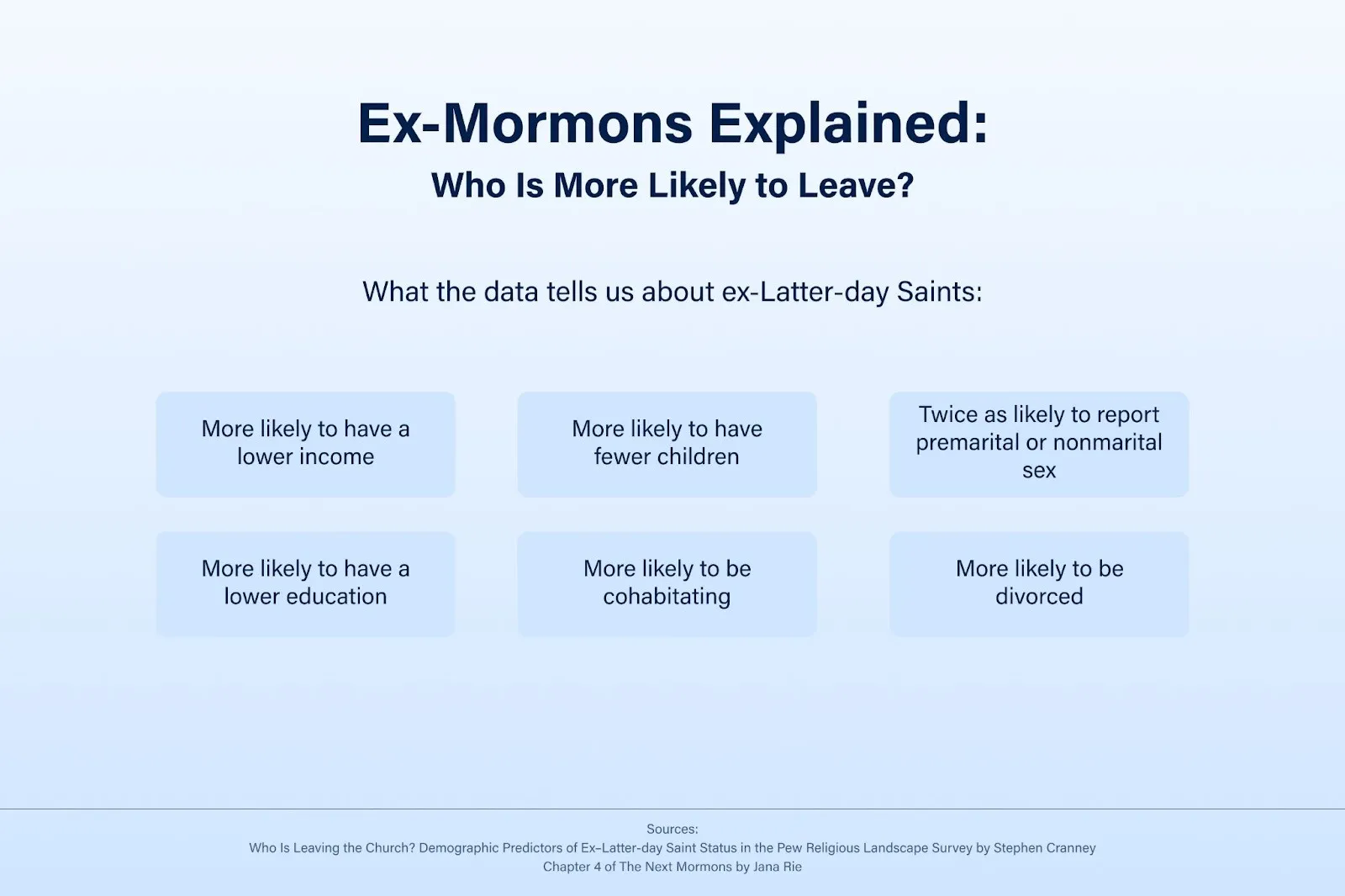
According to Cranney’s findings, ex-Latter-day Saint couples are more likely to be cohabiting without being married and more likely to have fewer children than practicing Latter-day Saints. This makes sense, since nearly every Mormon leader has taught against pre-marital cohabitation and strongly emphasized the importance of building a family.
Divorce is a very strong predictor for an individual being an ex-Latter-day Saint rather than a current one. It’s difficult to determine the reason from the data alone, since we don’t know if these divorces happened before the individuals left the Church or after.
How A Male-Only Priesthood Affects Women’s Religiosity
In Mormonism, only worthy male members can be ordained to priesthood offices. In these roles, they are given assistance and authority from God to help them preside over a group they have responsibility over. Bishops, priests, apostles, and even fathers use their priesthood to guide and bless others in their respective spheres.
However, some have asked: why don’t women get the priesthood? Does lack of a priesthood office drive women away from the Church? In Latter-day Saint understanding, the priesthood is simply the power of God. Men and women have different roles both in the family and in the Church, but just because men are the only ones given priesthood offices in what are Mormons doesn’t mean they are the only ones who get to be blessed by the priesthood.
The Pew Research data reveals something very interesting about Latter-day Saint women’s religiosity. Despite being a Church with only male priesthood offices, those who leave the Church are disproportionately male, following the general trend in the United States of men being less religious than women.
In her book The Next Mormons, Jana Reiss observes that Mormon women tend to be more religiously orthodox than men, often finding comfort, empowerment, and belonging in Mormonism explained. In that vein of empowerment, Latter-day Saint women have begun to surpass Latter-day Saint men in college attendance.
Racial and Socioeconomic Factors
The Pew Research data indicates ex-Mormons are more likely to have less education and less income than active Mormons. Cranney determines that in this comparison, people who stay in the Church are more wealthy because they are more educated.
Mormonism is something of an anomaly in this area compared to most religions. While higher education generally correlates with lower religiosity throughout the world, the opposite is true for Latter-day Saints. This might be attributed to the Latter-day Saint belief that both religious and secular learning are godly pursuits.
Racial factors also show some correlations among Mormons and ex-Mormons in this Pew Research study. Non-white Latter-day Saints in the United States appear to be significantly more likely to leave the Church. However, these populations are under-represented in the study, potentially exaggerating the results.
Reiss reports on interviews she’s had with racially diverse Latter-day Saints in America, where Mormonism is predominantly white. She observes that although most Latter-day Saints are not intentionally racist, members who are part of racial minorities may still experience microaggressions and awkward situations. This can be stressful and isolating, making it more difficult for many non-white Latter-day Saints to find belonging and stay active.
Young Latter-day Saints’ Shifting Mentality
According to Reiss’s observations, a shift has occurred among younger Latter-day Saints in response to the cultural changes of the information age. In the past, Mormons were a more isolated community, identifying themselves through cultural similarities that set them apart from the rest of the world. However, today, the Church has spread to every continent, bringing in people and perspectives of all walks of life.
In this more diverse religion, younger Latter-day Saints are focusing more on their core commonalities of faith in Jesus Christ and serving God rather than identifying certain cultural patterns (i.e. caucasian, big families, living in Utah, marrying young, heterosexuality, Republicanism) as what “Mormon” looks like. There is an increasing recognition of Mormon leader not being infallible, leading to greater reliance on personal spirituality. This spirituality is necessary in the information age, where anti-faith materials such as the CES Letter are easily accessible.
A Future Shaped by Personal Authenticity and Spirituality
In recent years, general authorities of the Church have increasingly emphasized the importance of personal revelation and spiritual experiences in establishing strong belief. Many Latter-day Saints, particularly those of younger generations, have embraced this counsel wholeheartedly. As members come up against issues with organized religion and Mormonism explained that cause them to doubt, they can rely on their personal, spiritual feelings to anchor them to faith, even in the uncertainty of a changing world.
Sources
- https://byustudies.byu.edu/article/who-is-leaving-the-church-demographic-predictors-of-exlatter-day-saint-status-in-the-pew-religious-landscape-survey
- https://mormonr.org/qnas/qDXeR/church_growth_and_activity
- The Next Mormons: How Millennials are Changing the LDS Church by Jana Reiss
About Mormonism Explained: Mormonism Explained is a resource that was designed to provide objective and factual information about Mormonism, its history, doctrines, and policies. Our team of researchers consults experts and primary sources to present factual information on a variety of topics relevant to the Mormon Church.