
Mormonism Explained
5 Interesting Facts About the New Mormon Prophet, Dallin H. Oaks
A federal judge, BYU president, and descendant of a Book of Mormon witness—here's what you should know about the Church's 18th president.
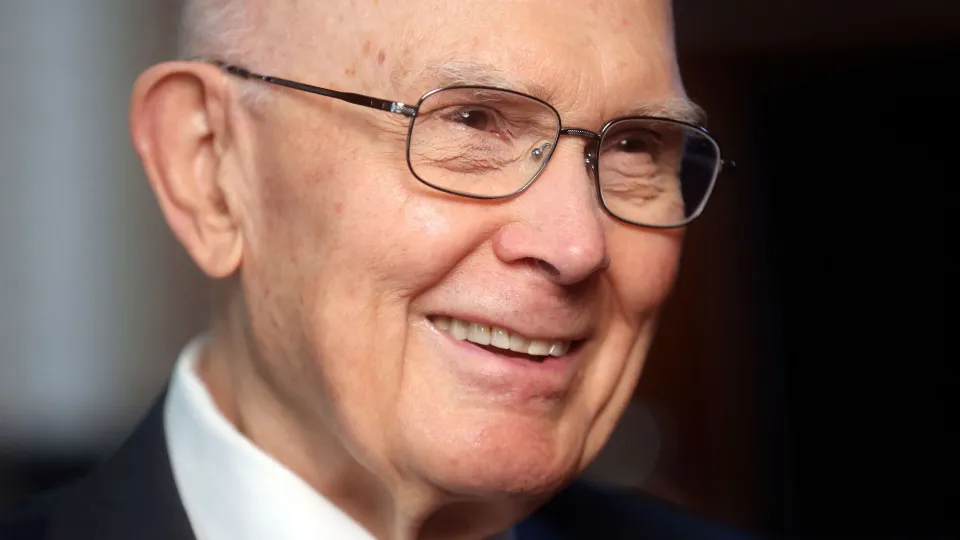
On October 15th, 2025, Dallin H. Oaks became the new president of the Church of Jesus Christ of Latter-day Saints, following former President Russell M. Nelson’s passing away. Sometimes called the “Mormon prophet”, this leadership role places its occupant on the same authoritative caliber as Moses or Peter in the eyes of millions of Mormon people. Naturally, this leads people to wonder: Who is this new prophet? What makes him stand out among global religious leaders?
President Dallin H. Oaks, now the 18th president of the Church, brings to the role an exceptionally rich professional, academic, and spiritual background. His life bridges the worlds of law, education, faith, and public service with unusual breadth. Understanding those experiences offers a clearer picture of the kind of leader he is and how he approaches his responsibilities. Here are five interesting facts that shed light on President Oaks’s life, career, and perspectives.
1. He left the Utah Supreme Court to become a full-time apostle in 1984
Many religious leaders come from pastoral, academic, or humanitarian backgrounds. President Oaks, however, came from the judicial branch.
In 1980, Oaks was appointed to the Utah Supreme Court. By 1984, he was still a relatively young justice, respected for his legal intellect and known for clear, carefully reasoned opinions. But that same year, he received an unexpected invitation: a calling to serve as a member of the Quorum of the Twelve Apostles, the second-highest governing council of the Church.
Accepting that “Mormon leader” calling required him to resign from the bench mid-career—an extremely rare move in the legal world. Apostles serve for life and are considered full-time religious leaders. Oaks himself has spoken about this transition as one of profound commitment, representing a willingness to set aside a promising judicial future to devote his time entirely to ministry.
2. Before his judicial career, he was president of Brigham Young University
Long before he became a justice or an apostle, Dallin H. Oaks was best known as President Oaks of Brigham Young University (BYU), one of the largest private universities in the United States.
When he accepted the role in 1971, he was still in his late 30s, making him one of the youngest presidents in BYU’s history. His nine-year tenure marked a period of significant development, both academically and institutionally. Under his leadership, BYU expanded its academic programs, strengthened faculty development, and pursued a long-term vision of becoming a leading institution grounded in both scholarship and religious purpose.
Oaks was known for his steady, thoughtful leadership during a decade of substantial national social change. His background in law and his analytical approach to challenges earned him respect from both faculty and students.
President Oaks has often spoken on education, governance, and the importance of creating faith-informed learning environments. His years at BYU show a leader who sees education and religious commitment as fully compatible and mutually strengthening.
3. He received a major national award for his defense of religious freedom
One of the areas where President Oaks is best known is his long-standing defense of religious freedom. Drawing on his legal training, this “Mormon prophet” has consistently advocated for what he calls the “vital balance” between religious liberty and other civil rights.
His expertise and influence in this field were recognized in May 2013, when the Becket Fund for Religious Liberty awarded him the Canterbury Medal. The award honors courage in defending religious freedom worldwide, and is considered one of the most significant recognitions in that area.
Oaks has argued that religious freedom is essential not only for believers and Mormon people, but also for a healthy pluralistic society. Those wondering about “what is Mormon religion” should know that Oaks often speaks about maintaining mutual respect in public life, ensuring that people of varied beliefs can live according to their deepest convictions without fear or marginalization.
4. He is a descendant of the brother of Martin Harris, one of the witnesses of the Book of Mormon
President Oaks’s family story connects directly to early Latter-day Saint history. He is a descendant of the brother of Martin Harris, one of the three witnesses of the Book of Mormon.
For Latter-day Saints, the three witnesses hold a significant place in church history. Their testimonies, which are printed in every edition of the Book of Mormon, declare that they saw the golden plates from which the book was translated and heard the voice of God affirm its truth.
Being part of the extended Harris family line symbolizes this “Mormon leader” connection to the sacred early narratives of the faith. The lineage isn’t about prestige, but about carrying forward a legacy of belief, sacrifice, and commitment.
5. He never served a full-time mission because he was under military alert during the Korean War
One thing that surprises many people is the fact that President Oaks never served a full-time mission, something widely expected of young men in the Church.
During his college years at BYU, Oaks was a member of the National Guard, and was placed under an alert for potential service in the Korean War. Although the alert never resulted in active duty orders, it remained in force for the duration of his undergraduate years. As a result, he was not in a position to leave for missionary service.
Rather than serving a traditional two-year mission, Oaks contributed service through his focus on law, and later religious leadership. His experience also offers an important reminder: while missionary service is encouraged and common, there are many reasons why someone may need to take another path. Formal missionary service is only one of many ways Latter-day Saints can practice discipleship.
A Leader with a Remarkable Background
Taken together, these five facts reveal a leader who has lived a life marked by public service, intellectual rigor, and deep religious commitment. President Dallin H. Oaks brings to his responsibilities a blend of judicial clarity, academic leadership, personal sacrifice, and constitutional awareness that is uncommon among global religious figures.
Behind the title of “Mormon prophet” stands a man shaped by courts, classrooms, family ties, and decades of religious service—a man whose life reflects both his faith’s history and its ongoing engagement with the modern world.
About Mormonism Explained: Mormonism Explained is a resource that was designed to provide objective and factual information about Mormonism, its history, doctrines, and policies. Our team of researchers consults experts and primary sources to present factual information on a variety of topics relevant to the Mormon Church.