
Last Updated: May 18, 2026
Emma Smith stands as one of the most complex and important figures in the early history of The Church of Jesus Christ of Latter-day Saints. Her life was marked by joy and profound sorrow, faith, and steadfast compassion. She played a critical role in shaping the early Church alongside her husband, Joseph Smith.
Born on July 10, 1804 in Willingsborough (later Harmony), Pennsylvania, Emma Hale was raised in a family of relative comfort on a 90-acre farm. She developed a strong sense of faith and spiritual conviction from a young age. Emma attended Methodist meetings with her mother and was known for her earnest prayers and devotion to God.
Her life took a dramatic turn when, at 21, she met 19-year-old Joseph Smith, who would later found the Church. The two eloped and were married on January 18, 1827. Emma’s family initially opposed the union, but this step marked the beginning of a partnership that would shape Church history.
“An Elect Lady”: Emma Smith’s Calling
Shortly after the organization of the Church in April 1830, Emma Hale Smith was baptized by Oliver Cowdery. Within weeks, Joseph Smith received a revelation directed to Emma, which is now canonized as Doctrine and Covenants Section 25. This revelation designated her as “an elect lady” charged to comfort the Prophet, expound scripture, and teach in the Church.
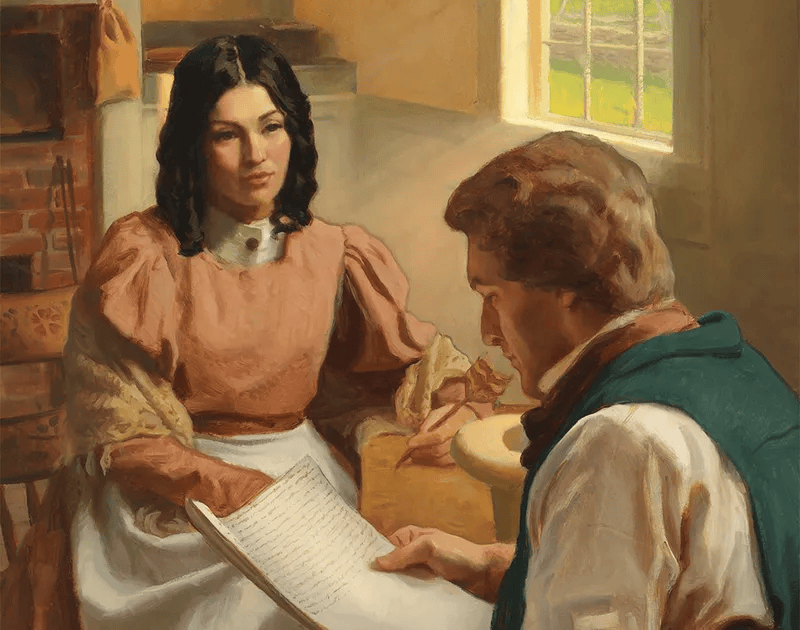
Even before this formal charge, Emma had been contributing in substantial ways. She served as one of Joseph’s earliest scribes during the translation of the Book of Mormon, and while no records indicate she ever viewed the plates with her eyes, she later said she’d felt their texture through their linen covering.
In Kirtland in the early 1830s, Emma Smith took on an uncommon responsibility for a woman of her time: curating a book of hymns for worship services. With William W. Phelps, she helped compile and print Church music, and in 1835, the first Latter-day Saint hymnbook was published in her name.
Emma’s Service, Charity, and Leadership
Emma’s role expanded as the Church grew. In Nauvoo, Illinois, where the Saints found refuge after persecution in Ohio and Missouri, she opened her home to the sick, orphaned, and destitute. Her compassion was not limited to members of her own family, but extended to the broader community during times of hardship.
In March 1842, Emma became the first president of the Female Relief Society of Nauvoo, a role of immense spiritual and organizational responsibility. Under her leadership, the Relief Society did much more than provide material relief. It became a center for teaching doctrine and fostering moral strength. Emma emphasized the principle that “charity never faileth,” setting a tone for Relief Society work that continues to inspire today.
Emma Hale Smith was the first woman to receive the endowment ordinance, and then helped administer it to other women under Joseph’s direction. Beyond ecclesiastical service, Emma acted as a representative of the Church in civic and public affairs. As Nauvoo’s unofficial “first lady,” she hosted dignitaries, appeared at community events with Joseph, and presented government petitions on behalf of the Church.
Trials, Love, and Endurance
Emma and Joseph’s marriage spanned seventeen years and was marked by both sincere devotion and intense conflict. They experienced persistent persecution, several children dying in infancy, financial struggles, and forced migrations, never being able to settle in the same place for long. Their correspondence during difficult periods like Joseph’s imprisonment in Liberty Jail reveals a deep love and mutual commitment. Joseph wrote to Emma in 1838, “My heart is entwined around yours forever and ever,” and Emma, in turn, expressed willingness to suffer for him if it was God’s will.
One especially painful and complex aspect of Emma’s life was her response to polygamy. While Joseph introduced the practice among a limited number of early Church members, Emma Smith struggled with the concept and its emotional repercussions. At times she supported the principle, consenting to Joseph’s sealings to several other women. At other moments, she strongly opposed it. Very little is documented about how Emma felt about Joseph Smith’s plural marriages. However, some historians believe that Joseph’s apparent hesitation to adopt the practice, which he believed was a divine commandment, was due to his concern for Emma’s feelings.
Emma’s Legacy After Joseph Smith’s Death
The assasination of Joseph and his brother Hyrum in June 1844 plunged Emma into a period of immense grief and uncertainty. Expecting their final child, she was left to care for her family alone. Emma assumed responsibility for Joseph’s estate and chose to remain in Nauvoo when most of the Saints migrated to the Salt Lake Valley. Disagreements over Church leadership and property ensued, and Emma never followed Brigham Young and the majority of Saints to the Great Basin.
In 1847, she married Lewis C. Bidamon, a resident of Nauvoo. Later, Emma affiliated with the Reorganized Church of Jesus Christ of Latter Day Saints (later the Community of Christ), led by her son, Joseph Smith III. Though her life took a path separate from the Utah-based Latter-day Saints, she continued to affirm her belief in the Book of Mormon and Joseph’s prophetic role.
Why did Emma Smith leave the Church? It’s a question with a complex answer, but some historians have noted that after experiencing so much grief over Joseph’s death, the idea of bringing her children on the very dangerous trek to the Utah Territory without him would have seemed terrifying to Emma. Her concern for her children’s safety, as well as her disagreements with Brigham Young, were likely important factors in her decision. To answer the question of was Emma Smith excommunicated, the answer is no—Emma chose to affiliate with the Reorganized Church on her own.
Emma passed away on April 30, 1879 in Nauvoo, still remembered by many as a model of resilience and compassionate service. Her influence lives on in the ongoing work of the Relief Society and in the hymns, teachings, and charitable ministries she helped inspire.
A Lasting Witness of Faith
The life of Emma Smith embodies both the joy and deep sorrow experienced by many members of the early Church. Although she endured instability, hostility, and grief during much of her life, she remained highly devoted in her roles as a wife, mother, and religious leader.
After Emma’s decision to separate from the Church, there were many members who regarded her negatively as an apostate. However, those who knew her, like her mother-in-law, Lucy Mack Smith, continued to regard her as a courageous woman who had patiently endured more suffering than almost anyone can imagine. By the 1970s, Latter-day Saints began to look at Emma’s legacy in a more charitable light. The Church commissioned statues and artwork remembering her, and her example is often spoken of in sermons, Sunday school lessons, and Latter-day Saint literature.
About Mormonism Explained
Mormonism Explained is a resource that was designed to provide objective and factual information about Mormonism, its history, doctrines, and policies. Our team of researchers consults experts and primary sources to present factual information on a variety of topics relevant to the Mormon Church.
Tags