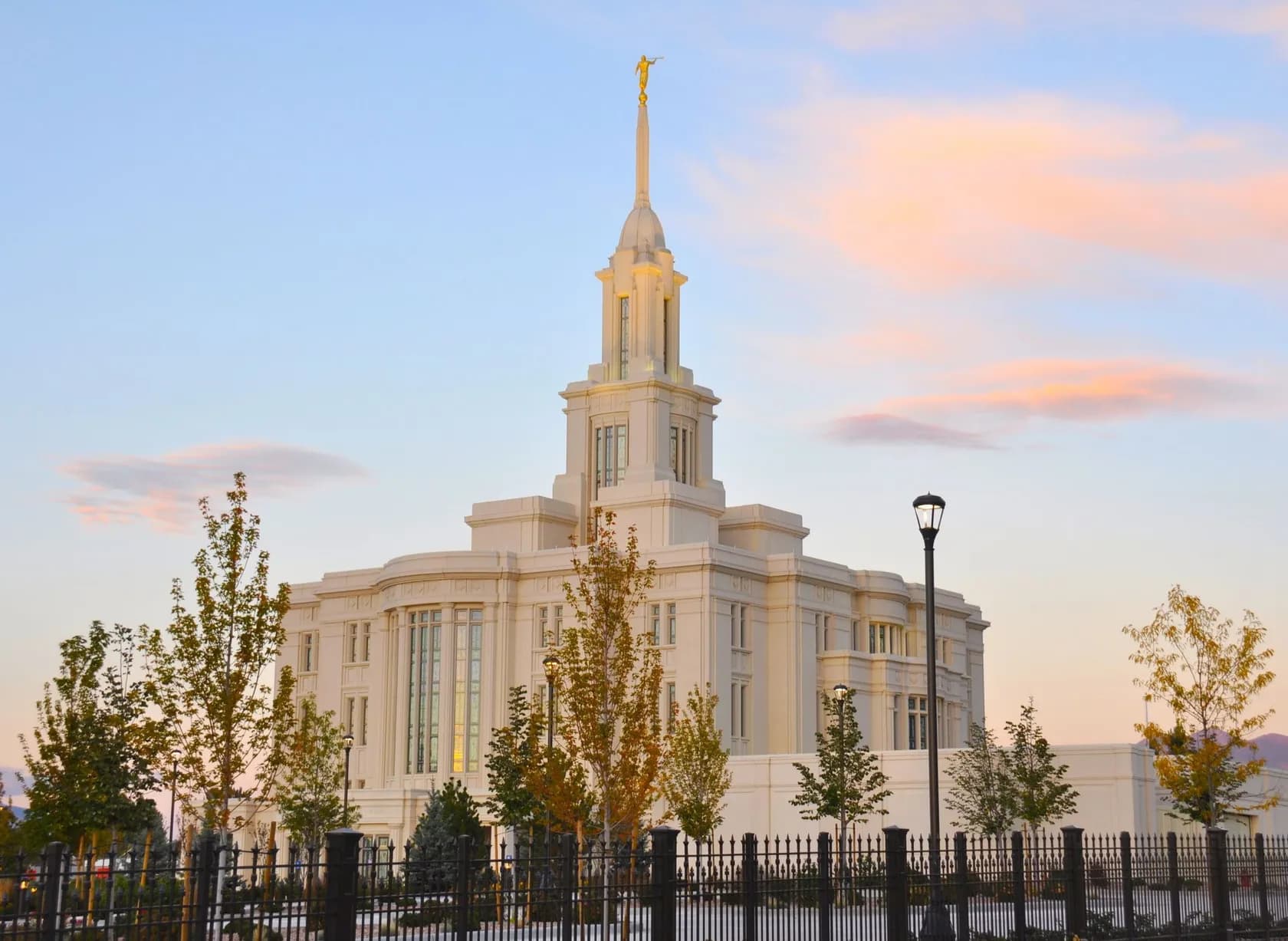
For many Christians, temples are regarded as an Old Testament concept that ended with Christ, and are no longer needed. But for Latter-day Saints, or Mormons, temples are central to their worship today. But what does the Bible actually say about temples, temple ceremonies, and sacred clothing?
Here are three common questions about Mormon temples that can provide some insights into why Latter-day Saints hold temple worship as a critical part of their faith.
1. Do Mormon Temple Ceremonies Have Any Basis in the Bible?
Yes. Latter-day Saint temple practices echo the detailed descriptions of temple worship in the Old Testament, including sacred space, authorized participants, ordinances, and ceremonial clothing, including temple garments. One of the clearest examples appears in Exodus, where the Lord instructs Moses concerning the Tabernacle, the portable temple used by ancient Israel.
Aaron and his sons—those authorized to minister in the holy places—were commanded to wear specific garments: coats, girdles, bonnets, breeches, and other items described as “holy garments…for glory and for beauty” (see Exodus 28). These garments were worn only when entering the sacred space of the tabernacle to officiate before God. The Lord states that they were to be worn “when they come in unto the tabernacle…that they bear not iniquity, and die,” emphasizing both the holiness of the space and the seriousness of the ordinances performed there.
The broader context matters as well. The tabernacle, and later the temple of Solomon, was designed as a symbolic journey toward the presence of God. Moving inward meant moving closer to holiness, culminating in the Holy of Holies. Temple worship was about covenant, consecration, and communion with God, not merely ritual for ritual’s sake.
While Latter-day Saints do not claim that their ceremonies in modern Mormon temples are identical to ancient ones, they do see continuity in purpose and pattern. The Bible clearly establishes that God has, in the past, used temples, ordinances, and sacred clothing as part of His revealed worship. Practices such as wearing Mormon temple garments are intended to reflect this.
2. Is there Anything in the New Testament about the Temple or Temple Ceremonial Clothing?
The New Testament contains strong evidence for the continued importance of the temple (and therefore, use of ceremonial clothing) during and after Christ’s mortal ministry.
Jesus Himself worshipped and taught at the temple. As a boy, He astonished teachers there. As an adult, He cleansed the temple, demonstrating not disdain for the temple itself, but zeal for its holiness. Christ declared, “Think not that I am come to destroy the law, or the prophets: I am not come to destroy, but to fulfil” (Matthew 5:17). Fulfillment does not mean erasure. Rather, it means bringing something to its intended, higher purpose.
Certain elements of the Law of Moses, most notably animal sacrifice, were fulfilled and no longer required after Christ’s atoning sacrifice. But the temple itself was not abolished. The idea that temples disappeared because they were only part of the “old law” oversimplifies the biblical record.
After Christ’s death and resurrection, the apostles continued to worship and teach at the temple in Jerusalem. The Book of Acts repeatedly tells that Peter, John, Paul, and other believers were there daily. In Acts 22, Paul recounts receiving a vision of Christ while praying in the temple well after Christ’s resurrection. This is difficult to reconcile with the idea that temple worship had suddenly become obsolete.
Some point to Stephen’s speech in Acts 7 where he says God “dwelleth not in temples made with hands” as evidence that physical temples were no longer required. However, when this passage is examined in context, it’s clear that Stephen was not condemning the temple itself; he was condemning the idea that God could be confined to it, or that temple worship had become an end rather than a means. It’s noteworthy that the same early Christians who preserved Stephen’s words were still worshipping at the temple daily (Acts 2:46).
In other words, the New Testament presents a both/and model: God can be worshipped anywhere, yet designated sacred space still matters.
3. Is there any Biblical Indication that Temple Ceremonial Clothing is a Continued Commandment?
To answer this, it’s necessary to look at the broader biblical narrative.
Before Israel formally received the Law of Moses, the people covenanted directly with God. They were invited to become “a kingdom of priests,” suggesting that at one time, all—not just the few allowed in the Holy of Holies—were meant to enter God’s presence. The law Moses received the first time on Mount Sinai focused heavily on the temple and God dwelling among His people.
However, that vision was interrupted. While Moses was on the mount, Israel broke their covenant by worshipping a golden calf. As a result, the higher law was withdrawn, and a preparatory law—the Law of Moses—was given instead. Temple access was restricted, priesthood authority and temple garments were limited to Aaron and his sons, and ordinances became intercessory and symbolic, pointing forward to Christ.
In the Latter-day Saint perspective, this explains why temple ordinances in the Old Testament appear limited and exclusive compared to how they are done today. They were not God’s original intent for humanity, but a temporary accommodation.
The New Testament then presents a restoration of higher authority. Christ ordained His apostles, giving them priesthood power after the order of Melchizedek. After His resurrection, He taught them over a period that mirrors Moses’ time on Sinai. Following Christ’s ascension, where do we find the apostles? Teaching daily in the temple.
Latter-day Saints believe that God has always required ordinances and covenants for salvation. Baptism by water and by the Spirit is commanded. The sacrament renews these covenants regularly. And entry into the fullness of God’s presence—what the Bible calls the “holiest”—has always been associated with temple worship.
While the Bible does not spell out modern LDS endowment garments in detail, it establishes a consistent principle: when God invites His children into sacred space to make covenants, He often sets apart that worship through symbolism, authority, and holy attire. Doctrine and Covenants 84 (a latter-day revelation cherished by Latter-day Saints) connects this ancient pattern to modern practice, but the biblical foundation is already there.
So Why Temples Today?
In ancient Jerusalem, Jews worshipped at a temple, including Christ Himself. Early Christians worshipped there, even after Christ’s resurrection. Yet centuries later, temples faded from Christian practice, largely due to persecution, destruction of the Jerusalem temple, and what Latter-day Saints believe was a gradual loss of priesthood authority and sacred ordinances.
From an LDS perspective, Mormon temples and LDS temple garments are not an anachronisms, but a necessary restoration of something ancient and biblical, now adapted to the higher law of Christ. They exist not to limit God, but to invite people more fully into His presence through covenants.
Whether one ultimately accepts that belief or not, the Bible itself makes one thing clear: temples mattered deeply to God’s people, to Christ, and to the earliest Christians. The question of what happened to that practice may be one of the most biblical things a modern Christian can ask.
By Todd Noall, Source Expert
Todd Noall is an author and religious scholar at Mormonism Explained with a focus on the history and theology of religion.
Fact Checked by Mr. Kevin Prince, Source Expert
Kevin Prince is a religious scholar and host of the Gospel Learning Youtube channel. His channel has garnered over 41,000 subscribers and accumulated over 4.5 million views. Mr. Prince also created the Gospel Learning App, a reliable platform where individuals seeking truth can access trustworthy answers to religious questions from top educators worldwide.
About Mormonism Explained
Mormonism Explained is a resource that was designed to provide objective and factual information about Mormonism, its history, doctrines, and policies. Our team of researchers consults experts and primary sources to present factual information on a variety of topics relevant to the Mormon Church.

Tags