
Last Updated: May 18, 2026
For many people, the first thing that comes to mind when they hear “The Church of Jesus Christ of Latter-day Saints,” or “Mormons,” might be polygamy. But can Mormons have multiple wives today?
The short answer is no. Members of the Church today do not practice polygamy, and anyone who attempts to do so can be excommunicated. However, the history behind that answer is complex and often misunderstood, since plural marriage was practiced by some Latter-day Saints during the 19th century. It began under the direction of Church leaders, was publicly practiced for several decades, and then was officially discontinued. Understanding this history requires looking at how and why the practice began, what it meant to early Latter-day Saints, and how it eventually came to an end.
The Doctrine of Marriage in Latter-day Saint Belief
Before discussing plural marriage, it is important to understand the general doctrine of marriage and polygamy definition in Latter-day Saint theology. According to church teachings, monogamy is the Lord’s standard law of marriage. The Book of Mormon reinforces this principle, teaching that ordinarily a man should have “one wife” unless God commands otherwise for specific purposes.
Latter-day Saints believe that God has sometimes commanded plural marriage at certain periods in history. Examples appear in the Old Testament, where prophets such as Abraham, Jacob, and David had multiple wives. Early members of the Church believed that Mormon polygamy was another instance in which God temporarily commanded something different for a specific purpose.
From the Latter-day Saint perspective, plural marriage was therefore not a permanent standard, but an exceptional commandment given during a specific period.
The Origins of Plural Marriage in the Early Church
Plural marriage in the Church traces its origins to the early 1830s. Church founder Joseph Smith reported that he had prayed about the biblical practice of plural marriage and received revelation instructing him to reintroduce the principle among God’s people. Polygamy was then introduced gradually and privately among a small number of trusted church members in the early 1840s in places such as Kirtland, Ohio and Nauvoo, Illinois.
For many early Saints, the principle was difficult to accept. Most converts came from monogamous backgrounds and found the idea culturally unfamiliar and emotionally challenging. Even some leaders, including Brigham Young, struggled deeply before eventually accepting polygamy as a matter of faith.
Plural marriage was also closely connected to another central doctrine being introduced during that time: eternal marriage, or the belief that families can be sealed together beyond death. Within this broader theological framework, some early Latter-day Saints saw plural marriage as part of God’s plan to strengthen families and build a strong community.
Plural Marriage in Nauvoo
During the early 1840s in Nauvoo, plural marriage expanded slowly among select members. The first known plural marriage in the city occurred in 1841. By the time Joseph Smith died in 1844, a relatively small group of believers had entered into plural marriages. Historical records indicate that dozens of men and women were involved in the practice during that early period.
Participants usually kept the practice confidential. This was partly because it polygamy was highly controversial in American society, and rumors about it contributed to social tension and hostility toward the Church. Despite these challenges, many early Saints who practiced plural marriage later described it as a transformative spiritual test. Some wrote that they accepted the practice only after prayer and personal spiritual conviction.
Public Practice of Polygamy in Utah
Plural marriage became more publicly known after Latter-day Saints migrated west to what is now Utah. By 1852, Church leaders openly acknowledged the practice. Even then, plural marriage was never practiced by the majority of Church members. Historians estimate that only about 15–20 percent of Mormon families in Utah were polygamous at the time it was practiced. About two thirds of the men in polygamous marriages did not have more than two wives.
Participation was regulated by Church leadership and typically limited to those who had the financial means and spiritual standing to support additional families. The first wife’s consent was generally expected before entering a plural marriage.
Plural marriage shaped many early Latter-day Saint communities. Large extended families were common, and plural households sometimes worked cooperatively to manage homes, farms, and businesses. However, the practice also generated intense national controversy.
Growing Conflict with the United States Government
Throughout the late 19th century, the U.S. government passed several laws targeting plural marriage in the Utah Territory. These laws criminalized the practice and allowed federal authorities to prosecute those involved. As legal pressure increased, many church leaders faced arrest, imprisonment, or the confiscation of church property. By the late 1880s, the situation had become increasingly severe.
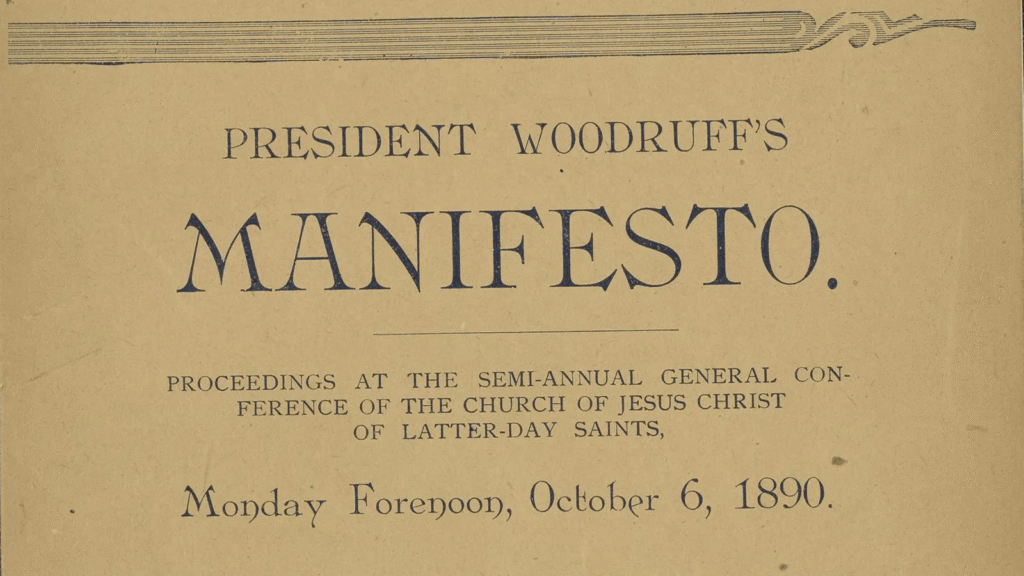
In 1890, Church president Wilford Woodruff announced what became known as the Manifesto, declaring that the Church would discontinue the practice of plural marriage and instructing members to obey the laws of the land. This marked a turning point in Latter-day Saint history. Woodruff later explained that he believed the decision came through divine guidance and that continuing the practice would have brought serious consequences to the Church and its temples.
The Gradual End of Mormon Polygamy
Although the 1890 Manifesto formally ended the commandment to practice plural marriage, the transition back to universal monogamy took time. Some plural marriages continued to be performed for a few years afterward, particularly outside the United States. However, in 1904, Church president Joseph F. Smith issued the Second Manifesto, making it clear that anyone entering into or performing a plural marriage would face excommunication. After that declaration, Mormon polygamy ceased. Existing plural families continued to live together, but no new plural marriages were permitted.
Why Some Groups Still Practice Polygamy
One source of confusion today is the existence of small groups in the western United States and Canada that still practice polygamy and sometimes identify themselves as “Mormon.” These groups are not affiliated with the mainstream Church of Jesus Christ of Latter-day Saints. Most of them originated in the early 20th century when individuals who wanted to continue practicing plural marriage separated from the main body of the Church, forming their own factions. Because of their shared historical roots, outsiders sometimes mistakenly assume they are part of the same organization.
What the Church Teaches Today
Today, plural marriage is strictly prohibited for members of The Church of Jesus Christ of Latter-day Saints. Anyone who practices it is subject to the both the consequences of the law and Church discipline, and will lose their membership.
Modern Latter-day Saints overwhelmingly live in monogamous families, just like most people around the world. While the historical practice remains an important part of Church history, it is not part of contemporary life for members of the Church.
Understanding the Past
Plural marriage remains one of the most discussed aspects of Latter-day Saint history. For many people both inside and outside the faith, it raises difficult questions about culture, doctrine, and the challenges faced by early believers. From the perspective of faithful Latter-day Saints, plural marriage represents a complex chapter in which early members tried to follow what they believed was a commandment from God, even when it conflicted with social norms and personal comfort. At the same time, members today recognize that the commandment was temporary and that the Church now fully embraces monogamous marriage as the standard.
So, Can Mormons Have Multiple Wives Today?
Do Mormons have multiple wives today? The answer is no. Members of The Church of Jesus Christ of Latter-day Saints do not practice polygamy today, and doing so would result in removal from the Church.
Mormons practiced plural marriage for several decades in the 19th century, but stopped with the Manifesto in 1890 and subsequent clarifications in the early 20th century. Today, Latter-day Saints honor the sacrifices and experiences of their early pioneers while living a very different family structure than the one that existed during that earlier period.
About Mormonism Explained
Mormonism Explained is a resource that was designed to provide objective and factual information about Mormonism, its history, doctrines, and policies. Our team of researchers consults experts and primary sources to present factual information on a variety of topics relevant to the Mormon Church.
Tags