
Mormonism Explained
Is Mormon Culture Starving Its Members?
A widely-read new book argues the Church’s culture fails at belonging, nourishment, and trust. That is a claim about human outcomes — which means it can be checked. So we checked it against every major study that has measured Mormons.
Start With What the Book Gets Right
Be kinder to people who are struggling with their faith. Don’t assume they left because they were lazy, or shallow, or offended by something someone said in Sunday School. Listen before you diagnose.
That is the pastoral core of Torn, Jeff Strong’s 2026 book on Latter-day Saint disaffiliation, and it is correct. We are not going to spend a word arguing otherwise. We are going to point out that it isn’t new.
Year
Source
Counsel
Year
Source
Counsel
Year
Source
Counsel
The Church’s own resource, “Helping Others with Their Questions,” instructs members to respond with love, humility, kindness, and patience, and to preserve relationships rather than win arguments.
The best advice in Torn is advice the Church has been giving for over a decade.
But the book does something the counsel never did. It builds a diagnosis. And a diagnosis can be tested.
The Claim Underneath the Kindness
Tornargues that Latter-day Saint culture is the load-bearing cause of disaffiliation — that it substitutes conformity for belonging, fear for love, and boundary-keeping for nourishment. Strong’s own word for what results is starvation. Spiritual starvation.
Read that as a metaphor and it is a sermon. Read it as a description of what is happening to millions of people, and it becomes something else: a prediction.
If a culture is starving its people, that should be visible in the people.
Starvation leaves marks. It shows up in how loved people felt growing up. In how much meaning they find in their lives. In whether they are depressed. In whether the young ones stay. In how long they live.
All of those things have been measured — repeatedly, by institutions with no stake in the answer. Harvard. Pew. UCLA. The University of Chicago. Some of the largest social-science instruments ever built have pointed themselves at this small religious group, some of them for decades.
So the question is not whether Strong’s thesis is compassionate. It plainly is. The question is whether the marks are there.
How to read what follows
Each section states the prediction Strong’s thesis makes, then the finding from the strongest instrument that has tested it. Every figure is source-tagged. Where the data cuts against us, we say so — including one global finding we report unprompted because no one else has raised it.
Test One: Are They Starving for Meaning?
Torn states
Members are spiritually starving — the culture gives them rules where it should give them nourishment.
The facts
Latter-day Saints rank #1 of any religion in the world on meaning and purpose — the measure of whether people say their lives have direction and matter.
That finding comes from the Global Flourishing Study, a $43.4 million collaboration between Harvard, Baylor, Gallup, and the Center for Open Science. It surveyed more than 200,000 people across 22 countries and follows them over time. It is, by a wide margin, the largest instrument ever built for this question.
On the axis that most directly measures spiritual nourishment, the group Strong describes as starving finishes first in the world.
Test Two: Does the Culture Fail at Belonging?
Torn states
The culture prizes conformity over connection. People do not feel they belong.
The facts
The highest rates in the entire Harvard study — and the mechanism the researchers themselves point to.
94% / 90%
Latter-day Saints who report having felt loved by their mother, and by their father, growing up — the highest of any group in the study. Groups more distant from faith report 85–87% for a mother and 79–80% for a father.
This is the finding we would keep if we could keep only one. Not because it is the most flattering, but because it is the most upstream. Whatever else a culture does, if it is producing children who felt loved by both parents at the highest rate anyone has measured, it is not failing at belonging.
Test Three: Are They Hurting?
Torn states
People inside the culture are quietly suffering under its weight.
The facts
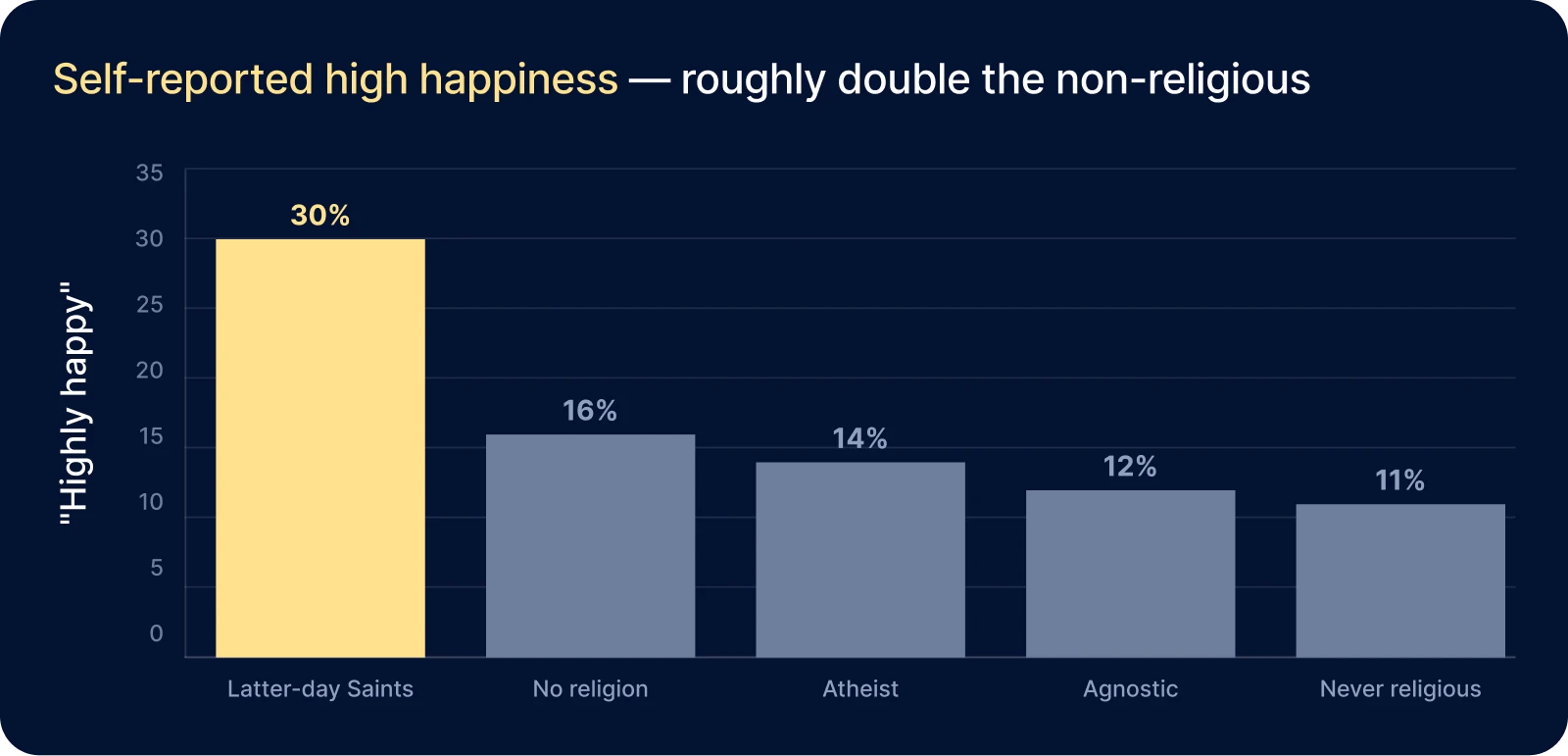
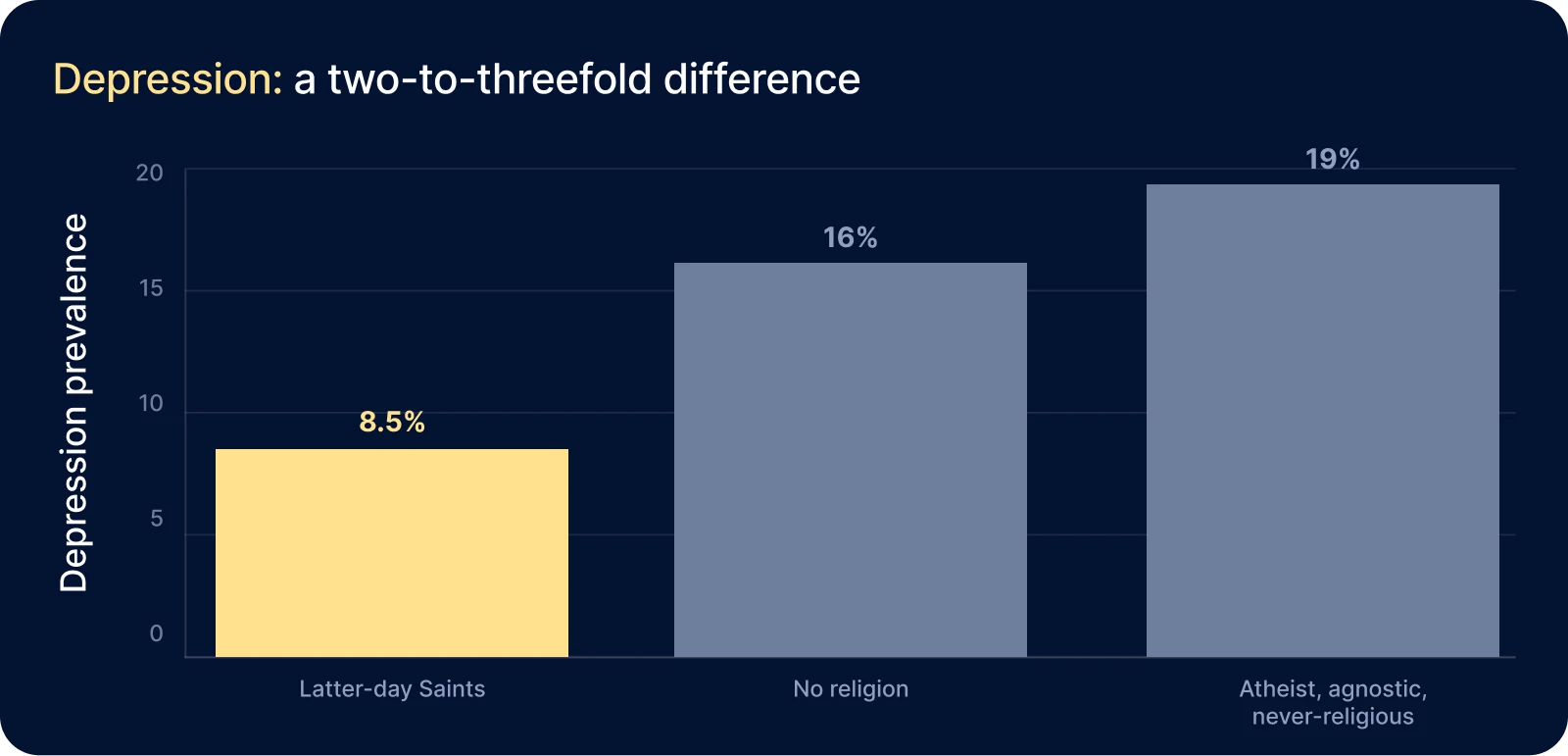
Roughly double the non-religious rate of high happiness, and depression at a third to half the comparison rates.
One place we will not overclaim
On the combined flourishing index — the composite of all domains — the picture is more complicated than the individual measures, and we would rather explain it than skip it.
Raw, Latter-day Saints land in the top three of major religions. But an independent analyst — Alex Bass, writing at Mormon Metrics— working the study’s public data found that once you control for age, income, education, geography, marital status and worship attendance, that advantage largely disappears: Latter-day Saints sit near the middle of the Protestant pack, with Hindus first and Catholics second, and are no longer statistically more likely to flourish than average.
So: not first place on the composite. We have seen this reported as an outright win and it is not one.
Should Marriage and Church Attendance Be Controlled for at All?
The composite result turns entirely on that question — and it is the analyst’s own caveat, not our rationalization.
Controlling for a variable assumes it is background noise you want held constant. But if the way a faith helps people flourish is by nudging them toward marriage and a tight-knit congregation, then those are not background noise. They are the mechanism.
Adjust them away and you are not isolating the religion’s effect. You are removing how the religion works and measuring what is left over.
The raw numbers
What the Latter-day Saint life actually produces, structural features included. Top three of major religions.
The adjusted numbers
What remains once marriage, attendance and income are stripped out. Middle of the pack.
Both are worth reading, and neither is the whole answer. We report both because a reader who only sees one will be misled — in one direction or the other.
If a church’s effect runs through marriage and congregation, then controlling for marriage and congregation controls away the church.
Test Four: Are the Young Ones Leaving?
Torn states
Trust is breaking, and it is breaking hardest with the rising generation.
The facts
76% of Latter-day Saint Millennials and Gen Z attend religious services at least monthly — more than any other major U.S. group.

And It’s Not Just What They Say
Survey answers about church attendance are notoriously generous. People round up. So Devin Pope, an economist at the University of Chicago, went around the problem entirely: he used anonymized smartphone location data from roughly 2.1 million devices to observe who actually walks into a place of worship, and when.
Latter-day Saints came out among the highest weekly attenders in America — confirming the self-reports with observed behavior.
You can argue with a survey. It is harder to argue with where people’s feet went.
Test Five: Does It Harm People Over Time?
Torn states
Whatever the culture is doing to people, the damage compounds across a life.
The facts
A 25-year cohort study run by UCLA and funded by the American Cancer Society found life expectancies of 84.1 and 86.1 years.
That is the Enstrom and Breslow cohort, published in Preventive Medicine, and it is the longest lens available. Not a snapshot of how people feel this year, but a quarter-century of following the same people to see how long they lived. The funder had no stake in the outcome.
Whatever the culture is doing, its members live measurably longer under it.
Test Six: Are the Thoughtful Ones the Ones Leaving?
Torn states
The people leaving are the thoughtful, educated, questioning members — the ones the culture has no room for.
The facts
92% of college-graduate members are highly religiously committed, versus 78% of those with less education.
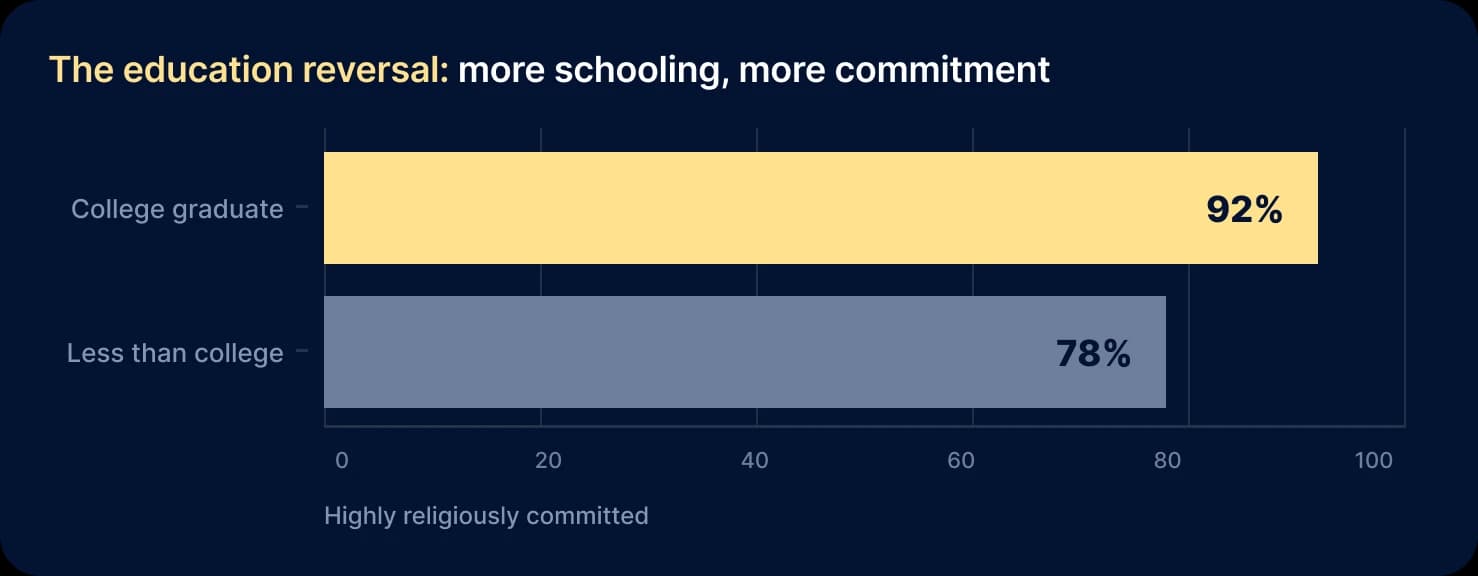
Nationally, education pushes religious commitment down. Among Latter-day Saints it runs the other way — a reversal of the standard gradient, and a difficult result for any thesis that treats leaving as the thoughtful person’s response to the culture.
Now the Strongest Argument Against Everything Above
Here is the objection that a careful reader of Torn should raise, and that we would raise ourselves.
Maybe the flourishing people are simply the ones who stayed. The starved ones left — and left the sample.
This is a real problem, not a rhetorical one. It is called survivorship bias, and it is the single most serious challenge to every finding above. If the culture drives people out and they stop being counted as Latter-day Saints, then measuring the ones who remain will always show a healthy population — the same way measuring only the runners who finished shows a fast race.
We do not think it explains the results, for three reasons. The felt-love finding is retrospective — it asks adults about their childhoods, including adults who later left. The longevity cohort tracked people for twenty-five years rather than sampling the survivors of a process. And the education reversal runs the wrong direction for the thesis: if the culture pushed out its most questioning members, commitment should fall with schooling, not rise.
But “we do not think so” is not evidence. So we are running the test properly.
What we are doing about it
The Global Flourishing Study’s microdata is publicly accessible through the Center for Open Science. We are pre-registering an analysis that compares current members, former members, and the general population directly — and publishing the method before we see the results, so we cannot quietly change the question if the answer disappoints us.
One Finding We Report Unprompted
Worldwide, Latter-day Saints measure weaker on the mental-and-physical-health axis of the Global Flourishing Study — even in the same data where U.S. depression runs low. Nobody asked us about this. It is real, it is unexplained, and it sits at the top of our research agenda.
What the Instruments Say
Ten studies. Five decades. Not one of them run by the Church.
The prediction
The finding
Instrument
The prediction
The finding
Instrument
The prediction
The finding
Instrument
The prediction
The finding
Instrument
The prediction
The finding
Instrument
The prediction
The finding
Instrument
The prediction
The finding
Instrument
A “starving” people don’t look like this.
What We Are Not Claiming
Not that nobody leaves — retention has softened and we published that finding ourselves. Not that no one has been hurt by a ward, a leader, or a culture; individual harm is real and is not answered by an average. Not that these numbers prove causation; they cannot, and we say so.
What we are claiming is narrower and harder to dismiss: if Latter-day Saint culture were starving its members, five decades of independent measurement would show it. It shows the opposite.
Frequently Asked Questions
Is Mormon culture harmful to its members?
The research record does not support that conclusion. Across ten independent instruments — including Harvard’s Global Flourishing Study, the Pew Religious Landscape Study, a 25-year UCLA mortality cohort, and University of Chicago geolocation data — Latter-day Saints show the highest reported childhood parental love of any group measured, roughly double the non-religious rate of high happiness, depression at a third to half comparison rates, the strongest young-adult attendance in the country, and among the longest life expectancies in America. None of these studies was run by the Church.
Are Mormons happy?
In the Global Flourishing Study, 30% of Latter-day Saints report being highly happy — statistically tied with several other conservative Christian faiths, and roughly double the rate among the non-religious (16%), atheists (14%), agnostics (12%), and the never-religious (11%). On the combined flourishing index the picture is more mixed: Latter-day Saints rank in the top three of major religions unadjusted, but near the middle of the Protestant pack once age, income, education, geography, marital status and worship attendance are controlled for.
What is the Mormon depression rate?
The Global Flourishing Study measured depression at 8.5% among U.S. Latter-day Saints — one of the lowest levels in the study, two to three times lower than groups more distant from faith (16% no religion; 19% atheist, agnostic and never-religious). Worldwide, however, Latter-day Saints rank third lowest of any religion on the study’s combined mental-and-physical-health domain, though above the religiously unaffiliated and Buddhists — a finding we report unprompted and are investigating.
Do Mormons live longer?
A 25-year cohort study conducted at UCLA and funded by the American Cancer Society found life expectancies of 84.1 and 86.1 years among the population studied — among the longest measured in the United States.
Do educated Mormons leave the Church?
Pew’s 2024 data shows the opposite pattern from the national norm: 92% of college-graduate Latter-day Saints are highly religiously committed, versus 78% of those with less education. Nationally, higher education is associated with lower religious commitment.
What about people who left — wouldn’t they show worse outcomes?
This is the strongest objection to outcomes research, known as survivorship bias. Three findings cut against it: the parental-love measure is retrospective and includes adults who later left; the longevity cohort followed people for 25 years rather than sampling survivors; and the education reversal runs opposite to what the thesis predicts. Mormonism Explained is pre-registering an analysis of the Global Flourishing Study microdata to test the objection directly.
Sources
- Global Flourishing Study — Harvard, Baylor, Gallup, and the Center for Open Science. hfh.fas.harvard.edu/global-flourishing-study
- Independent adjusted-domain analysis of the Global Flourishing Study — Alex Bass, Mormon Metrics. The adjusted composite result and its mediator caveat are his. mormonmetrics.com
- Pew Research Center, Religious Landscape Study (2023–24) — attendance by generation and religious commitment by education. pewresearch.org/religion/religious-landscape-study
- James E. Enstrom & Lester Breslow, “Lifestyle and reduced mortality among active California Mormons, 1980–2004,” Preventive Medicine 46 (2008): 133–36 — the 25-year UCLA cohort, funded by the American Cancer Society, that reported life expectancies of 84.1 years for men and 86.1 for women. pubmed.ncbi.nlm.nih.gov/17920112
- Devin Pope, “Religious Worship Attendance in America: Evidence from Cellphone Data,” Becker Friedman Institute, University of Chicago (NBER Working Paper 32334) — observed attendance from anonymized smartphone geolocation. bfi.uchicago.edu
- Dieter F. Uchtdorf, “Come, Join with Us” (October 2013); M. Russell Ballard, “The Opportunities and Responsibilities of CES Teachers in the 21st Century” (February 2016); Russell M. Nelson, “Peacemakers Needed” (April 2023); and the Church resource “Helping Others with Their Questions.”
- Jeff Strong, Torn: Why People We Love Are Leaving the Church and What We Can Learn from Them (2026) — the book under review. tornbyjeffstrong.com
- Companion investigation: Have 40% of Mormons Left the Church? — the membership ledger behind the retention finding cited above.