
Mormonism Explained
Are Gay Mormon Kids Safe in the Mormon Church? What the Data Actually Shows
It’s the most serious accusation made against the Church today: that it endangers its own gay kids. We wanted the actual answer — not the internet’s. So this study starts where honesty requires: gay and LGBTQ youth face elevated risk everywhere, stated without flinching. Then it opens the largest representative dataset ever gathered on the question — 86,346 Utah teens — its independent replications, and the finding at the center of all of them. The answer is not what most people expect.
If this topic is heavy for you
The Short Answer
Are gay Mormon kids safe in the Mormon Church — or does growing up Latter-day Saint put them at greater risk?
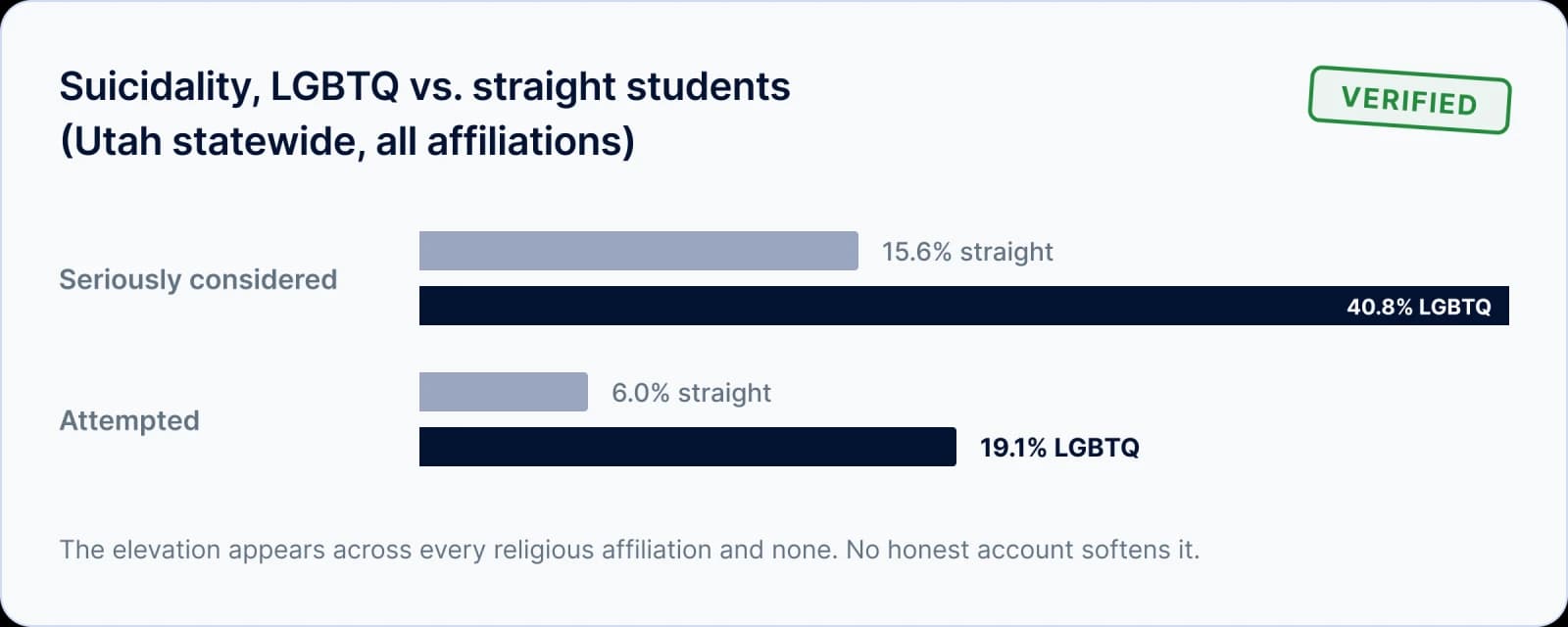
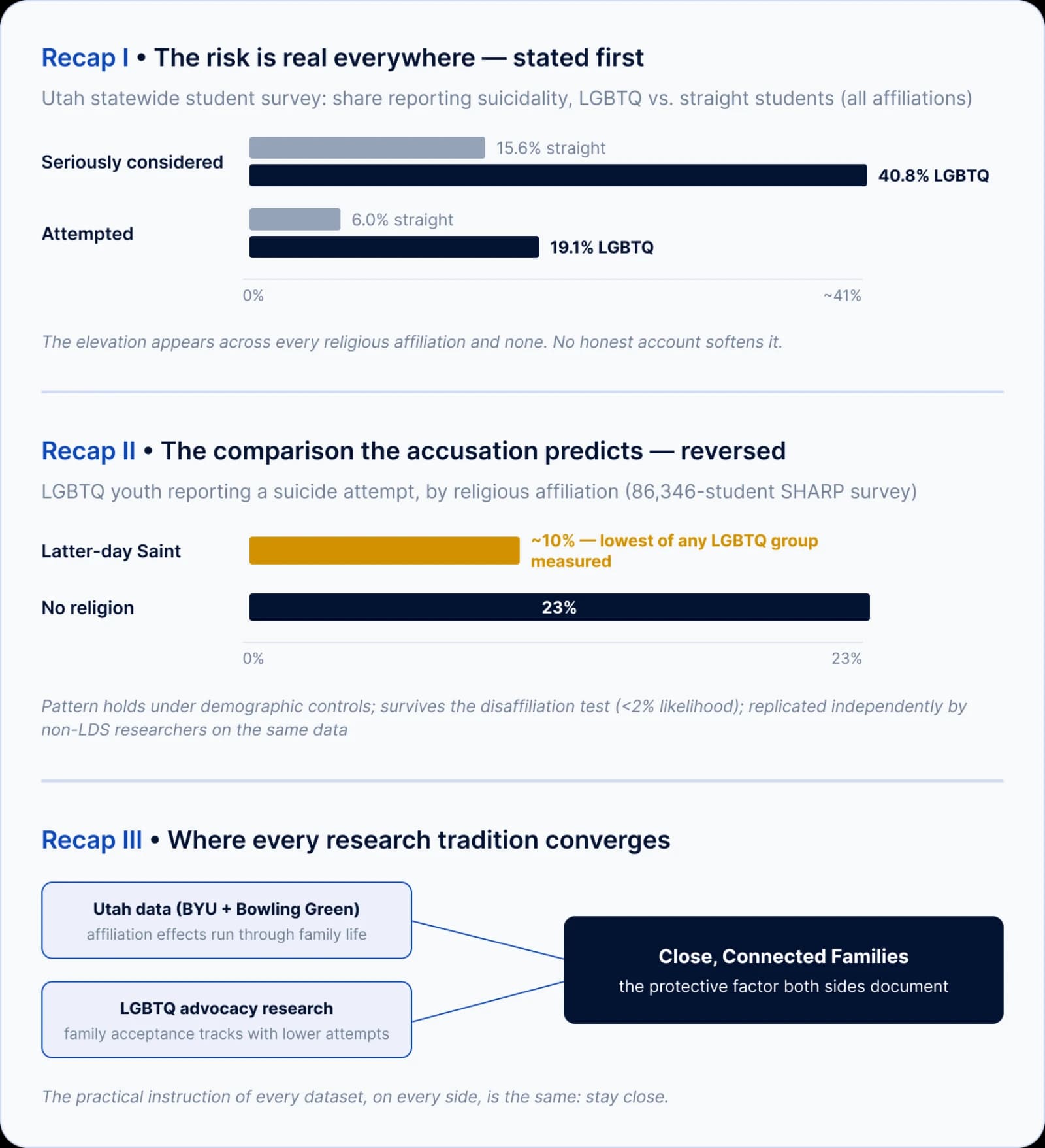
Two facts are true at once, and we’re going to state both plainly. First: gay and LGBTQ kids face elevated suicide risk everywhere — including inside The Church of Jesus Christ of Latter-day Saints. In Utah’s statewide data, LGBTQ students were far more likely than straight peers to have seriously considered suicide (40.8% versus 15.6%) or attempted it (19.1% versus 6.0%). Nothing here softens that; a lower relative risk is still a risk.
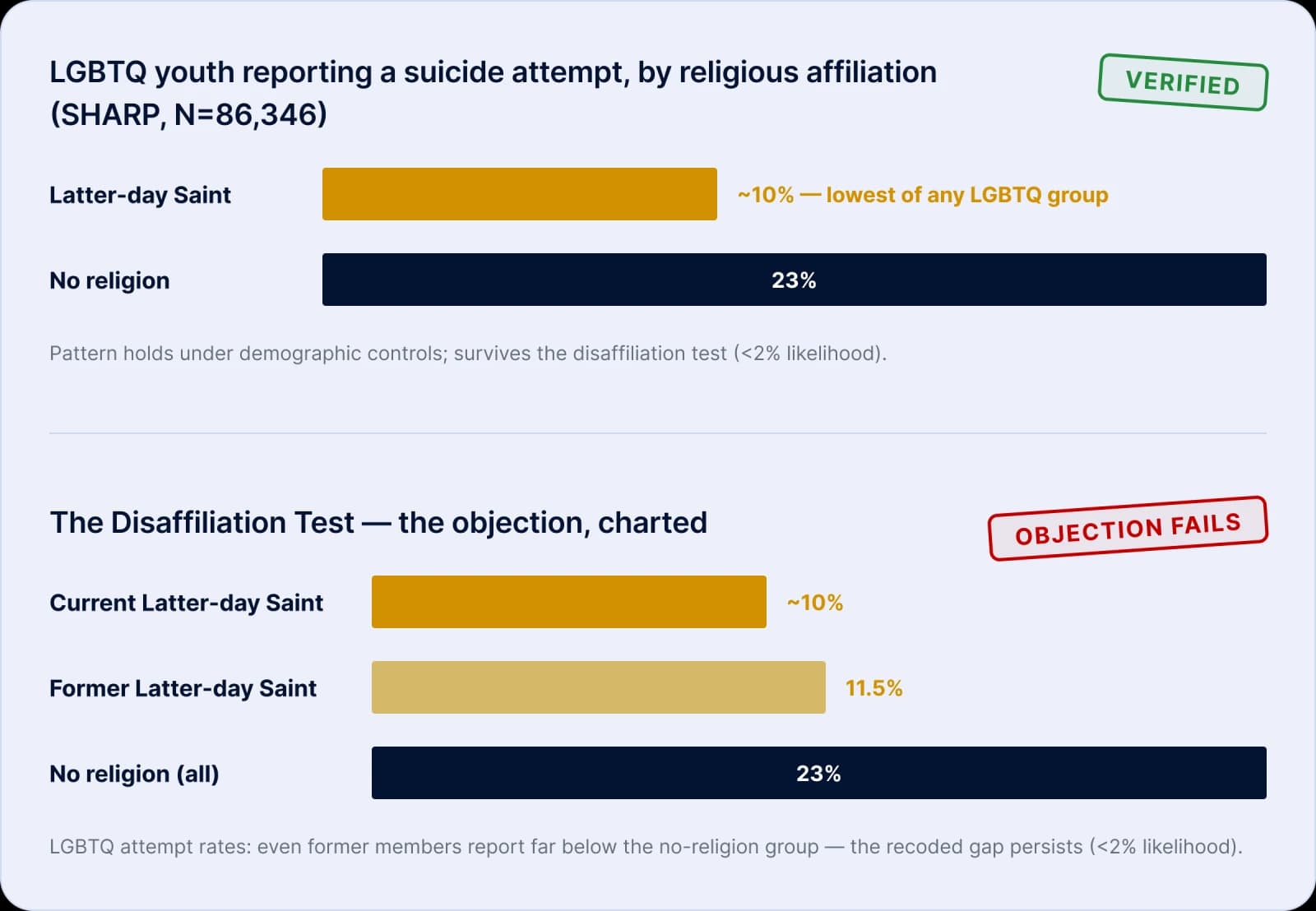
Second: the claim everyone has heard — that a gay Mormon teenager is in more danger inside the Church than outside it — is contradicted by the best data that exists. In the largest study ever run on the question — 86,346 Utah students, surveyed by the state, not the Church — gay and LGBTQ Latter-day Saint youth reported the lowest suicidality of any LGBTQ group measured: roughly 10% reporting an attempt versus 23% of LGBTQ peers with no religion. It held under controls. It survived the researchers’ attempt to kill their own finding. And a team with no ties to the Church — Bowling Green State University, publishing in an APA journal — read the same data and found the same thing.
The engine, in study after study, isn’t membership as a talisman. It’s what membership tends to build: close, connected, low-conflict families. That’s where this study ends, because it’s where every side’s data points. One note before we begin: suicide is never the result of a single factor — and this page carries crisis resources throughout.
Key Takeaways
- The elevated risk is real and stated first. LGBTQ youth report far higher suicidality than straight peers everywhere — across all religions and none. We do not soften this.
- The best data contradicts the accusation.In Utah’s representative 86,346-student SHARP survey, LGBTQ Latter-day Saint youth showed the lowest suicidality of any LGBTQ group — roughly 10% reporting an attempt versus 23% of no-religion LGBTQ peers.
- Non-Latter-day-Saint researchers replicated it. A Bowling Green State University team analyzed the same dataset independently and likewise found LGBTQ Latter-day Saints at lower suicide risk than peers of other faiths or none.
- The “they all left” objection was tested. The researchers modeled disaffiliation directly and found it very unlikely (under 2%) that departures explain the difference.
- The mechanism is families. The differences were almost entirely explained by family closeness and lower substance use — the same lever LGBTQ advocacy research identifies. Both literatures point at the same thing.
- Suicide is never single-cause. This study makes no single-factor claims in either direction — the same standard we hold critics to.
The critics’ reading: “The Church is dangerous for LGBTQ youth — its teachings drive them to despair”
The claim: a faith that cannot affirm same-sex relationships necessarily harms LGBTQ young people, and Utah’s youth suicide problem is the proof.
Steelmanned below
The record: “In the best representative data, LGBTQ Latter-day Saint youth are as safe or safer than LGBTQ peers of any faith or none”
The documented picture: elevated LGBTQ risk owned everywhere; the lowest measured suicidality among LGBTQ Latter-day Saints; independent replication; and family closeness as the engine.
Risk owned — data replicated
The risk is real. The accusation is testable. It was tested — and the data runs the other way.
Why This Page Exists
The Accusation, Taken Seriously
No accusation against The Church of Jesus Christ of Latter-day Saints carries higher stakes than this one. The claim is not that the Church is mistaken about history or doctrine; it is that the Church’s teachings actively endanger the lives of its own LGBTQ children — that a Latter-day Saint upbringing is, for a gay or lesbian teenager, a risk factor for suicide. That claim circulates in documentaries, celebrity statements, and viral death counts — and in the quiet fears of Latter-day Saint parents. It deserves neither defensiveness nor dismissal but the two things it has rarely received: complete seriousness about the suffering underneath it, and complete precision about the evidence.
This study commits to both. It also commits, at the outset, to the standard responsible suicide research demands: suicide is never the result of a single factor. No church membership, policy, teaching, or identity — alone — causes a suicide, and none alone prevents one. That standard binds everyone — the loudest causal claims against the Church violate it, and this study will not violate it in the Church’s favor either. What the evidence can establish is comparative and specific: whether LGBTQ Latter-day Saint young people, as a group, fare worse than LGBTQ young people outside the Church. That question has now been asked of the largest representative dataset ever gathered on the subject — and the answer is the opposite of the accusation.
No Flinching
The Hard Facts First
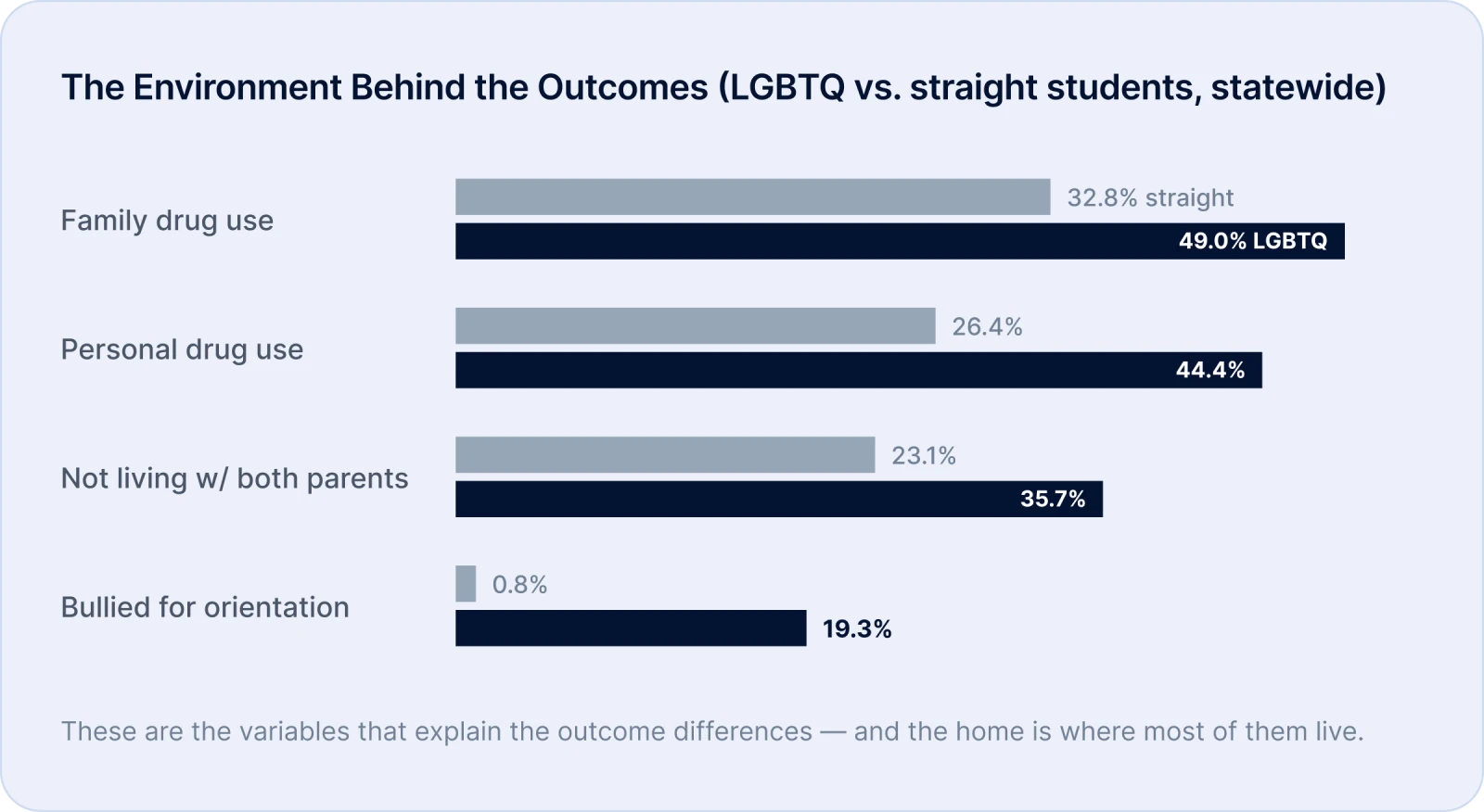
Before any comparison between groups, the fact that frames everything: LGBTQ young people report dramatically elevated suicidality compared with their straight peers, everywhere researchers have looked — and that includes inside the Church. In Utah’s statewide SHARP survey, LGBTQ students were far more likely than straight students to have seriously considered suicide (40.8% versus 15.6%) and to have attempted it (19.1% versus 6.0%). They reported more family conflict, more bullying over their sexual orientation, and higher rates of household and personal substance use. That elevation appears across every religious affiliation and among those with none — being a Latter-day Saint does not erase it, and no honest treatment pretends otherwise. This page will not argue that LGBTQ Latter-day Saint youth are “fine,” and it will not treat a lower relative risk as if it were no risk.
A second honesty note concerns scope: the strongest data measures sexual orientation, while transgender youth appear in far smaller numbers (about 1.2% of the sample) and show higher risk generally; the findings below carry that limit marked, not stretched. And a third: these surveys measure suicidality — thoughts and attempts, reported anonymously — because no dataset anywhere records suicide deaths by both religion and sexual orientation; anyone claiming death-count precision, on any side, is claiming data that does not exist. With the hard facts stated, the comparative question can be asked honestly: within this elevated-risk population, how do Latter-day Saint youth compare?
The Best Data That Exists
The Largest Study: 86,346 Students
The central evidence is not a church survey, an advocacy poll, or an online convenience sample. It is the 2019 SHARP survey — collected by the Utah Department of Human Services from 86,346 students in grades 6, 8, 10, and 12, anonymous, weighted to represent all Utah youth. Within it, 7,205 students identified as lesbian, gay, bisexual, or questioning. Researchers Dyer, Goodman, and Wood analyzed it in BYU Studies Quarterly, asking directly whether gay and LGBTQ Latter-day Saint youth fare worse than LGBTQ peers of other religions or none.
The results ran opposite to the accusation. LGBTQ Latter-day Saints were not at higher suicidality risk than LGBTQ youth of any other affiliation — and were significantly lower than several groups. In the study’s religion-only models, an estimated 10% of LGBTQ Latter-day Saint youth reported having attempted suicide, versus 23% of LGBTQ youth reporting no religion — the lowest of any LGBTQ group in the data; the same pattern held for suicidal consideration and depression.
The researchers then attacked their own finding. The obvious objection — that the numbers look favorable only because the most distressed members had already left and been counted elsewhere — was modeled directly, using separate data on how many no-religion LGBTQ teens are former Latter-day Saints (60.5%). Recoding those former members as Latter-day Saints, the analysis found it very unlikely — under a 2% likelihood — that disaffiliation explains the gap. The finding survived its own strongest objection; and what elevates it further is what happened next — replication, on the same data, by researchers with no connection to the Church at all.
Not One Study — a Pattern
The Replications and the Wider Record
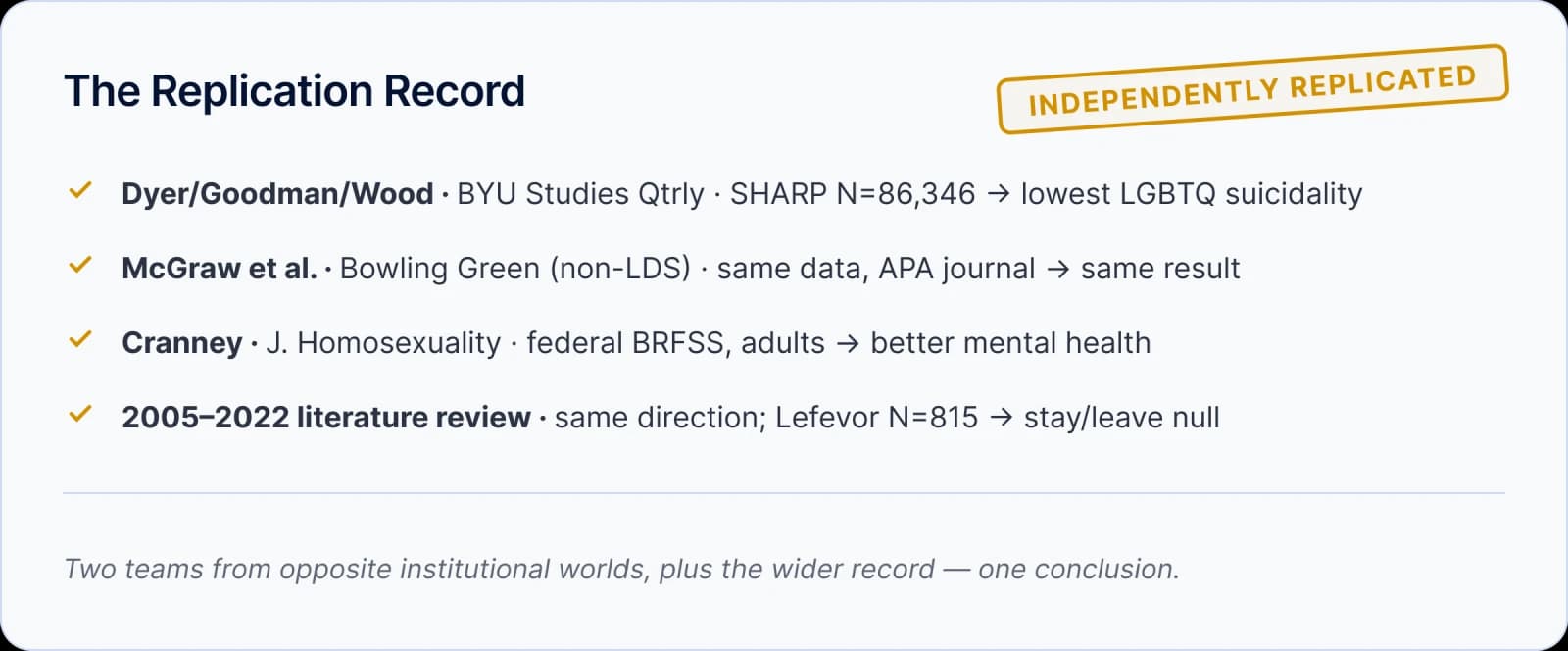
The single most important fact about the Utah finding is that it does not depend on Latter-day Saint researchers. A team from Bowling Green State University — James McGraw and colleagues, publishing in the American Psychological Association journal Psychology of Sexual Orientation and Gender Diversity — independently analyzed the same statewide dataset and likewise found that LGBTQ Latter-day Saints had lower suicide risk than LGBTQ peers of other faiths or no faith. Their framing differed: the Bowling Green team emphasized that LGBTQ youth of all affiliations remain at elevated risk and that family conflict tracks with worse outcomes everywhere — emphases this study shares. But on the comparative question, the two teams read the same data the same way.
The pattern extends beyond one survey. Using federal Behavioral Risk Factor Surveillance System data, sociologist Stephen Cranney found that Latter-day Saint sexual-minority adults in Utah reported better mental health than sexual-minority adults outside the Church — the adult echo of the youth finding. A 2023 review of the research literature from 2005 to 2022 found that studies of Latter-day Saint sexual minorities generally reported better mental health than their non-member counterparts.
And in a study designed around the stay-or-leave question itself, psychologist G. Tyler Lefevor — who is himself a former member and a leading researcher of LGBTQ Latter-day Saints — grouped 815 current and former members into engaged, moderately engaged, and lapsed profiles and found the three groups did not significantly differ in mental health, physical health, or life satisfaction. That null is quietly devastating: if the Church were the engine of suffering its critics describe, leaving should measurably help. In Lefevor’s data, it did not. The accusation has now been tested repeatedly, by believers and non-believers, on government data — and it keeps failing.
Where the Safety Actually Lives
The Mechanism: Families
The most useful finding in the Utah data is not the comparison — it is the explanation. When the BYU researchers added family and lifestyle variables to their models, the differences between religious groups largely dissolved: religious affiliation, by itself, stopped predicting suicidality once family closeness, family conflict, and substance use were taken into account. Some readers will mistake that for a weakness in the finding. It is the finding.
Membership in the Church is not a talisman; nothing about a name on a record protects a struggling teenager. What the data shows is that Latter-day Saint LGBTQ youth, on average, live in homes with markedly more connection, less conflict, and less substance use — and that those homes are where the protection lives. The researchers put it directly: religion appears to exert its greatest influence on youth wellbeing through its effects on family life.
This is also where the Church’s data and the strongest LGBTQ advocacy research converge. The Trevor Project — the largest LGBTQ youth crisis organization, no ally of religious conservatism — finds year after year that family acceptance is associated with dramatically lower attempt rates. The Bowling Green team found the same in Utah. Everyone’s data points at the same lever. And it is a lever the Church pulls constantly: a faith organized around the family — a theology in which the family is the eternal unit — produces, on average, precisely the environments the research literature identifies as protective.
For the Latter-day Saint parent of an LGBTQ child, the instruction of every dataset is identical: stay close. The Church’s current teaching says the same — rejection is the danger; love is an expression of faith, not a compromise. The data does not ask parents to choose between covenants and child; the covenant-keeping home, kept warm, is the safest place the data can find.
Steelmanning the Critics
The Strongest Objection
The strongest form of the critique does not rest on viral death counts; it rests on the national research literature and on minority-stress theory, and it deserves its full weight. Across national samples, the protective association between religiosity and mental health — one of the most reliable findings in public health — weakens, disappears, or reverses for sexual minorities. One national study of college students found that among those who rated religion as very important, sexual-minority status was more strongly associated with suicidal ideation, not less. Another, using federal survey data on more than 160,000 adults, found religious attendance associated with higher suicide risk among sexual minorities even as it predicted lower risk for heterosexuals. Minority-stress theory explains why: for a young person whose identity sits in tension with their community’s teachings, the community itself can become a source of chronic stress — and a church teaching that same-sex relationships are outside the law of chastity, the critic argues, builds that tension into the architecture of a gay member’s life. On this reading, the Utah findings are the anomaly requiring explanation, not the national pattern.
The response is not to wave the national literature away — it is to notice what the best of it actually says, and what the Utah data adds. Lefevor’s meta-analysis of 73 studies across five decades, published in Psychological Bulletin, found the full picture: religiousness is, on net, positively associated with health for sexual minorities — at roughly half the strength of the association for heterosexuals — with wide variation, including real harm in rejecting environments and real benefit in connected ones. The national pattern, in other words, is not “religion harms sexual minorities”; it is “context decides.”
And that is precisely what the Utah data illuminates: in a community whose religious life is built around family cohesion, the context comes out protective — not because doctrine changed, but because connection is the active ingredient and Latter-day Saint family life supplies it in unusual quantity. The minority-stress mechanism is real, and the disparities stated above are its footprint; but the theory predicts LGBTQ Latter-day Saints should fare worse than LGBTQ youth outside the Church, and in the best representative data they do not — they fare as well or better, a result replicated by researchers with every incentive to find otherwise. A theory is entitled to its mechanism. It is not entitled to override the direct measurement of the very outcome it predicts. The critic’s strongest argument, taken all the way to the data, ends as a finding about which environments protect — and the measured answer includes the one the accusation says cannot.
The Honest Answer
So — Are Gay Mormon Kids Safe in the Church?
Yes — and the data isn’t close. In the best representative data that exists — 86,346 Utah youth, replicated independently by non-Latter-day-Saint researchers — LGBTQ Latter-day Saint youth report the lowest rate of suicide attempts of any religious group — an estimated 10% versus 23% among peers of no religion — and are as safe or safer than their LGBTQ peers outside the Church. The claim that the Church endangers its LGBTQ youth is not supported by the record; it is contradicted by it.
And the protection is no accident: the factors researchers found doing the work — close, connected families and far lower substance use — are the very things a Latter-day Saint life is built to cultivate. As the study’s own authors put it, religion exerts its greatest influence on a young person’s wellbeing through its effect on the family.
The one-sentence version: the accusation runs opposite to the data — and the reason is families. We went looking for the danger everyone talks about. What the record showed us instead was the lowest measured risk of any faith — and a lever every parent, in any pew or none, can actually pull: stay close. That’s the whole finding. Check it yourself; every source is listed below.
The Shareable Summary
The Record at a Glance
The findings in one frame, from the study that produced each and the independent work that confirmed it — the point where every tradition converges. These figures also appear beside the sections that establish them; this page assembles them for sharing. Nothing is charted that is not documented in the sources below.
Quick Answers
Are LGBTQ Latter-day Saint youth at higher risk than LGBTQ youth outside the Church?
No — in the largest representative data (86,346 Utah students), they showed the lowest suicidality of any LGBTQ group: ~10% reporting an attempt vs. 23% of no-religion peers.
Lowest of any LGBTQ group measured
Are LGBTQ youth in the Church still at elevated risk?
Yes. LGBTQ youth everywhere — including Latter-day Saints — report far higher suicidality than straight peers (19.1% vs. 6.0% attempts statewide). We state this without qualification.
Yes
Owned, not softened
Was the study just BYU defending the Church?
No — a Bowling Green State University team independently analyzed the same government dataset and found the same comparative result, published in an APA journal.
Independently replicated
Don’t the struggling members just leave?
The researchers tested that directly, recoding former members back in; the disaffiliation explanation had under a 2% likelihood. Lefevor also found engaged and lapsed members didn’t differ in wellbeing.
Tested — under 2% likely
What actually protects LGBTQ youth?
Family closeness and connection — the finding of the BYU team, the Bowling Green team, and LGBTQ advocacy research alike. Affiliation alone predicted nothing once family variables entered.
Families — every dataset agrees
Did the 2015 policy cause a wave of suicides?
No such dataset exists anywhere. All findings here are suicidality (thoughts and attempts) from anonymous surveys; anyone claiming death-count precision is claiming data that doesn’t exist.
No
A limit both sides share
Frequently Asked Questions
Are LGBTQ youth safe in the Mormon Church?
Two things are true at once. LGBTQ youth report far higher suicidality than straight peers everywhere, including inside the Church — in Utah’s statewide data, 19.1% versus 6.0% for attempts. But compared with LGBTQ youth of other faiths or none, LGBTQ Latter-day Saint youth showed the lowest suicidality of any group measured in the largest representative dataset available: roughly 10% reporting an attempt against 23% of LGBTQ peers with no religion.
What is the suicide rate for LGBTQ Mormons compared to non-Mormons?
No dataset anywhere records suicide deaths by both religion and sexual orientation, so no death rate can be cited by anyone. What the 2019 Utah SHARP survey measures is suicidality — anonymous self-reports of thoughts and attempts. On that measure, an estimated 10% of LGBTQ Latter-day Saint youth reported an attempt, versus 23% of LGBTQ youth reporting no religion.
Did the study account for LGBTQ members who left the Church?
Yes, directly. The researchers modeled disaffiliation using separate data on how many no-religion LGBTQ Utah teens are former Latter-day Saints (60.5%), recoded those former members back in, and found it under 2% likely that departures explain the gap. A separate study by G. Tyler Lefevor found engaged, moderately engaged, and lapsed members did not significantly differ in mental health, physical health, or life satisfaction.
Doesn’t research show religion harms LGBTQ people?
The national literature is more precise than that. Lefevor’s meta-analysis of 73 studies across five decades, published in Psychological Bulletin, found religiousness is on net positively associated with health for sexual minorities — at roughly half the strength seen for heterosexuals — with wide variation: real harm in rejecting environments, real benefit in connected ones. The pattern is not “religion harms sexual minorities”; it is that context decides.
From the DMs
The Harder Questions, Answered
“BYU professors studying whether their own church hurts kids — of course they found what they found.”
Verdict: The same data was analyzed independently by non-Latter-day-Saint researchers at Bowling Green — who found the same thing.
“Even if the numbers are true, teaching a kid their feelings are sinful is harm all by itself.”
Verdict: The Church teaches that attraction is not a sin — and the outcome data is how we test claims of harm rather than assume them.
“Utah has one of the worst youth suicide rates in the country. That’s the Church’s fingerprint.”
Verdict: Utah sits in the eight-state “suicide belt” — and within it, the Latter-day Saint population shows lower, not higher, suicidality.
Sources
- Dyer, Goodman & Wood, “Religion and Sexual Orientation as Predictors of Utah Youth Suicidality,” BYU Studies Quarterly 61 (2022) — the SHARP analysis, the 10%-versus-23% figures, and the disaffiliation check (BYU affiliation disclosed). byustudies.byu.edu
- James S. McGraw et al., “Family, Faith, and Suicidal Thoughts and Behaviors Among LGBTQ Youth in Utah,” Psychology of Sexual Orientation and Gender Diversity (2021), doi:10.1037/sgd0000517 — the Bowling Green State University replication, published by the American Psychological Association. doi.org/10.1037/sgd0000517
- Stephen Cranney, “The LGB Mormon Paradox: Mental, Physical, and Self-Rated Health Among Mormon and Non-Mormon LGB Individuals in the Utah Behavioral Risk Factor Surveillance System,” Journal of Homosexuality 64:6 (2017): 731–44 — the adult echo of the youth finding. doi.org/10.1080/00918369.2016.1236587
- G. T. Lefevor et al., 73-study meta-analysis, Psychological Bulletin 147:7 (2021) — the context-decides finding engaged in §06; and the latent profile analysis of 815 Latter-day Saint sexual minorities finding no significant difference between engaged and lapsed groups.
- M. C. Lytle et al., American Journal of Preventive Medicine(2018) — the college-student study; and K. Park & N. Hsieh (2022) — the 160,000-adult federal-survey study. Together, the national-sample counter-literature stated at full strength in §06.
- 2019 SHARP survey, Utah Department of Human Services — the 86,346-student statewide dataset all of the above analyze.
- The Trevor Project, annual national survey on LGBTQ youth mental health — the family-acceptance finding that converges with the Utah data in §05. thetrevorproject.org
- Church suicide-prevention resources. churchofjesuschrist.org/get-help/suicide
- Companion studies: Can You Be Gay and Mormon?, Do Mormons Support LGBTQ People?, and Did 34 Gay Mormon Kids Die by Suicide From LDS Policy?